


Selling software used to be cool. Now, selling the work is cooler. But not the traditional way, with armies of people, producing lots of “stuff”, charging an arm and a leg. Today, people are hyped about AI-native services.
And I get it.
The market is big. Arguably bigger than the software market. Foundation Capital, a Palo Alto venture firm, framed the prize as “the $4.6T enterprises spend on salaries and services” rather than the “$200B SaaS market” for software-as-a-service.
The value proposition is clear. AI-native services companies promise the same quality with faster turnaround and, typically, at a lower cost. Crosby, an AI-native law firm that reviews and negotiates commercial contracts, charges a fixed fee per contract instead of billable hours or seats (estimated between $250-$1000 per contract). Harper, an AI-native commercial insurance brokerage, says it can handle more than 1,000 customers a month against 20 to 30 deals for a typical human sales team.
The revenue comes quickly. Customers pay for the work right away. You might provide a free trial, but generally speaking you’re landing paying customers immediately. Revenue is good.
The big question is this: can you deliver more work without needing proportionally more people, while maintaining quality and keeping enough of the efficiency gains?
Basically: do AI-native services companies scale with the economics their investors expect?
Getting paid and stealing a few clients from traditional service firms doesn’t answer that question.
This is what makes AI-native services so interesting, and potentially misleading. There’s no obvious category creation. You’re lifting and shifting spend to a faster, cheaper option.
You generate revenue immediately, and the revenue might grow quickly as customers are eager to feel “less screwed over” by expensive professional services, but that’s not exactly the same as genuine, scalable product-market fit.
Selling the work is a compelling idea
In August 2023, Benchmark partner Sarah Tavel encouraged founders to consider selling “the work itself” instead of software that makes workers more productive.
The distinction is straightforward.
A software company sells a lawyer a tool to review contracts. An AI-native law firm reviews the contracts for the customer directly.
The customer gets finished work. The provider figures out how to produce it using AI as much as possible, with humans (for now) in the loop for review.
The venture capital firm Emergence Capital, says that AI-native service companies become “the single point of responsibility.”
That’s key. Customers aren’t simply buying output. They’re buying someone’s commitment to deliver the work, answer questions and deal with problems. Customers still want a “throat to choke” and, I suspect, still believe in the expertise of these AI-native service companies, despite knowing that a lot of the work is done by AI.

Investors are pouring a lot of capital into AI-native services. Hanover Park, an AI-native fund administrator, raised a $27 million Series A in March 2026. AI-native insurance platform Corgi raised $160 million in May.
Many traditional service businesses are slow, expensive and frustrating to work with. Plenty have survived because switching is painful, the relationship feels safe, or everyone else is equally annoying (or undifferentiated).
Without question, there’s room for improvement.
But a massive market and unhappy customers don’t automatically create venture-scale businesses (although it’s a good place to start!) You still have to figure out what happens after customers start paying.
Revenue proves someone wants the work
Imagine launching an AI-native bookkeeping firm.
You find ten companies unhappy with their current bookkeepers. You promise faster turnaround, better communication and a lower price.
They sign up.
Your AI handles a meaningful chunk of the work. Your team handles everything else, including the weird transactions, missing documents and questions that start with, “This should be simple, but…”
Clients are happy. Revenue grows.
What have you learned?
You’ve learned that clients want bookkeeping and that your team can deliver it well enough to keep them happy.
That’s useful evidence.
But there’s still a lot to learn:
Will the next hundred clients require proportionally more staff?
Will your automations work beyond a narrow set of situations?
Will customers accept standardized delivery, or want everything to be bespoke?
Will quality survive when the founders stop checking everything?
Will your price cover the full cost of doing the work?
You can validate demand for a service while leaving the scalability of its delivery almost completely untested.
That’s OK early on. Many software companies operate the same way: first prove people will use the product, then that they’ll pay, then that you can get more customers, who also pay. But the underlying scale economics of software companies tend to be clearer (although AI is messing with those too).
AI-native services need to validate two things
If you’re building an AI-native services company, you need to establish two things:
Customers repeatedly choose you to do the work.
Your delivery system improves as the business grows.
The first drives revenue and retention, which helps establish product-market fit.
The second is central to the investment thesis: the expectation that you can grow substantially without delivery costs rising at the same rate.
They can move in different directions.
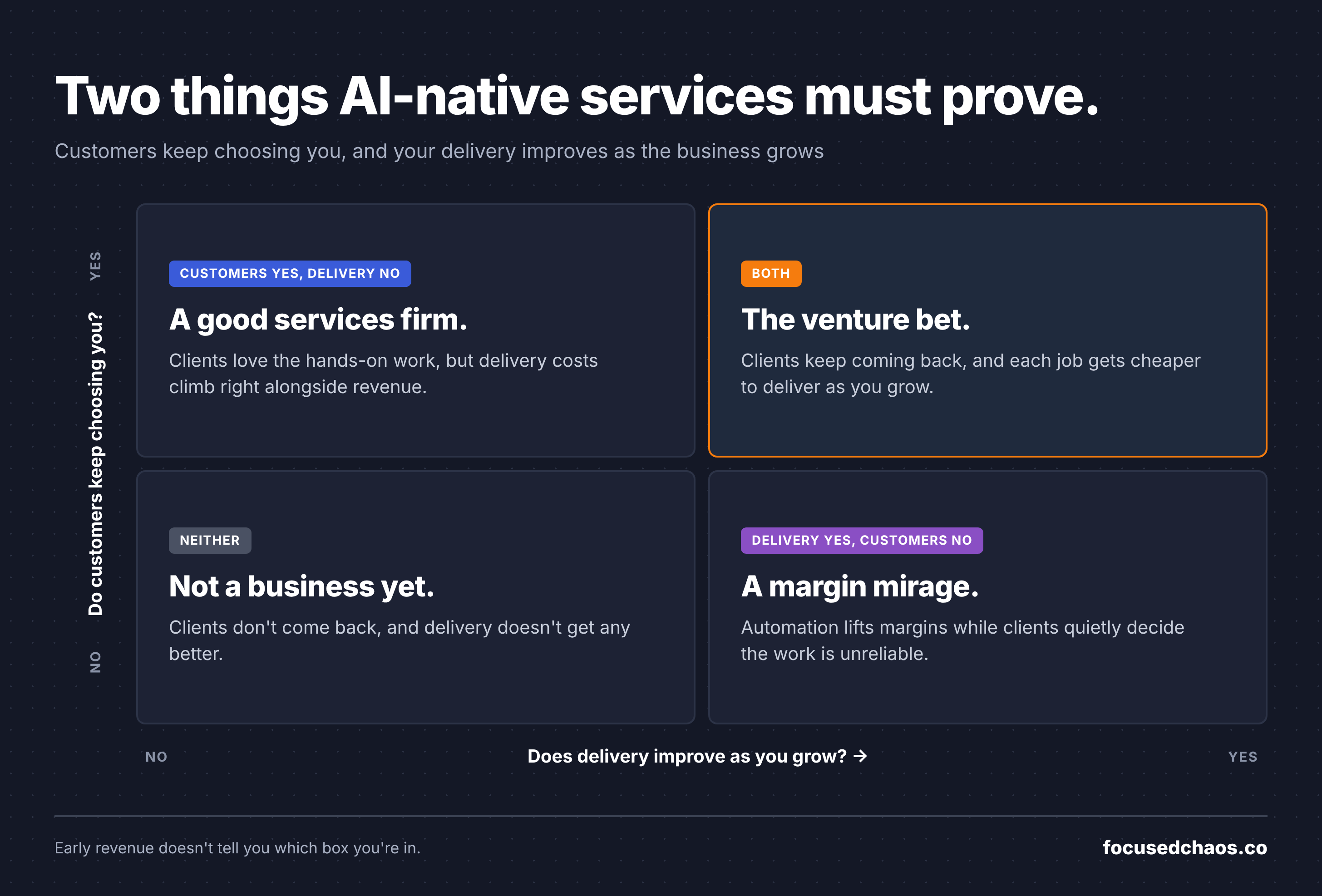
Your customers might love you because you assign experienced humans to every problem, customize everything and respond immediately. Meanwhile, your delivery costs climb alongside revenue.
You could also automate aggressively and improve margins while customers quietly decide the work is unreliable.
There is the potential for real tension between delivering value to customers and doing so cost effectively for your business.
This shows up clearly when talking about gross margins. Emergence Capital defines the gross margin tiers as follows:
Below 50%: a services business (with a venture cap table if they’ve raised VC).
Between 50%-70%: better than legacy services, but needs to be priced as one to compete.
Above 70%: potential to earn software multiples.
These are investor valuation benchmarks, rather than rules about what customers should pay.
The venture bet is that AI-native services can eventually achieve software-like margins. But early revenue doesn’t tell us whether they’ll get there. That requires evidence that automation improves delivery economics as the companies grow.
Applying Lean Analytics to AI-native services
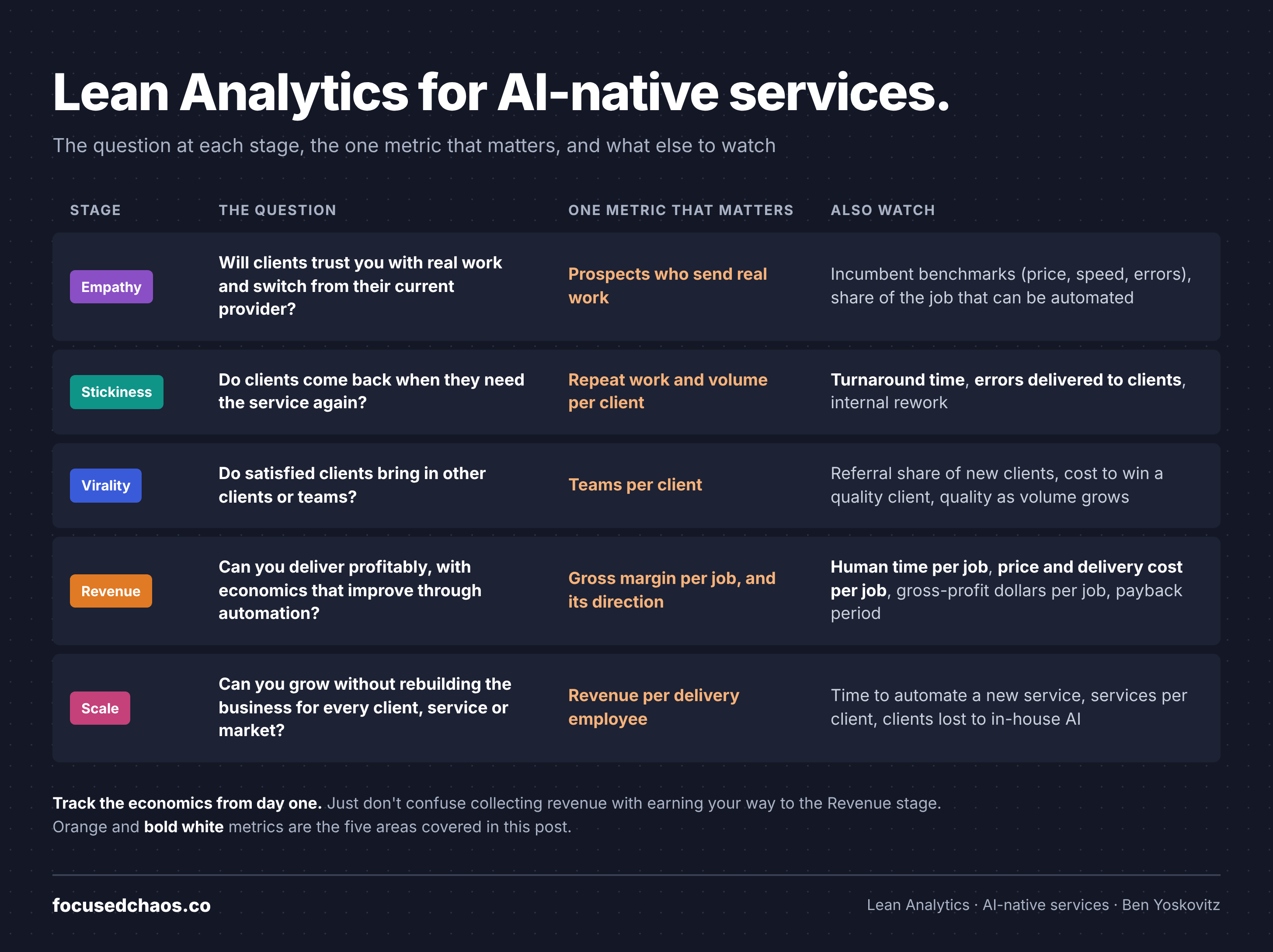
In Lean Analytics, Alistair Croll and I described five stages that every business goes through: Empathy, Stickiness, Virality, Revenue and Scale.
You need to be clear about which stage you’re at, so you can define the right metrics to track.
AI-native services can make the sequence confusing because revenue shows up immediately. You’re charging from day one and might assume you can skip to the Revenue stage.
But we defined the Revenue stage as the point when you’re truly optimizing the economic engine of the business. AI-native services businesses have a ton of work and validation to do before they get there.
Here’s how I’d apply the stages:
Empathy: Will customers trust you with real work and switch from their current provider? What specifically makes switching worthwhile?
Stickiness: Do customers return when they need the service again? Do they send more work because the experience was good?
Virality: Do satisfied customers bring in other customers or teams? Have you figured out how to quickly and cost-effectively acquire quality customers?
Revenue: Can you deliver profitably, with economics that improve through automation?
Scale: Can you grow without rebuilding the business for every client, service or market?
I’m a big fan of charging early. Same for software companies. But don’t assume a handful of customers paying you means you’ve nailed product-market fit or should immediately focus on squeezing more margin out of delivery.
If customers aren’t coming back, you still have a Stickiness problem. Automating more of an experience they don’t want to repeat won’t solve it.
Track the economics from day one. Just don’t confuse collecting revenue with having earned your way to the Revenue stage.
Five areas to track
The metrics to focus on need to answer a connected set of questions: are customers coming back, and can we deliver more work with less human effort without sacrificing quality or giving away the gains?
Here’s what I’d track.
1. Repeat work and volume per client
Do clients return when they need the service again? How much work do they send? Are other teams inside the account starting to use you?
Measure this against the natural frequency of the service. Monthly bookkeeping and occasional legal work won’t produce the same usage patterns.
Rising volume can indicate trust, but ask why it’s growing. Are clients happy with the work, taking advantage of a discount, or simply busier themselves?
2. Human time per job
Crosby calls this Human Review Time, or HURT: the minutes of lawyer time per document. It’s funny they call it “HURT”. They’re making it clear that lawyer time is painful!
Track all the human effort required to deliver the work, including reviews, corrections, exceptions, client questions and rework.
Include the founder who spends Sunday fixing something that was supposedly automated.
The goal is to reduce human effort while maintaining quality. Falling review time alone doesn’t prove the economics work, but it helps reveal whether AI is actually taking on more of the job.
3. Price, delivery cost and gross margin per job
Delivery cost needs to include the experts’ salaries and AI costs. Don’t bury the people doing the work in operating expenses to make gross margin look better.
Track price alongside cost. If both fall at the same pace, better automation won’t necessarily improve margins.
I’d also track gross-profit dollars per job. Percentages matter, but you need enough actual money left over to pay for everything else.
Early on, direction matters. 45% and climbing beats 60% and stuck, assuming underlying service quality and revenue are healthy too.
Finally, track revenue per employee. If revenue grows but revenue per employee stays flat, you may be scaling through hiring rather than automation. Separate delivery staff from total headcount so you can see where efficiency is improving, or where overhead is eating the gains. Watch pricing and service mix too: higher revenue per employee doesn’t automatically mean the AI is doing more work.
4. Turnaround time
Measure the time from receiving the work to delivering it.
This is often one of the first differences clients notice. Harper, an AI-native insurance brokerage, says it takes one to two days for work a traditional broker takes five to seven days to do.
Watch what happens as volume grows, and separate routine jobs from complex ones. A good average can hide a growing pile of difficult work.
Not everyone thinks speed is a value proposition. I asked for people’s thoughts on LinkedIn about AI-native services, and Nate Andorsky, Founder & CEO at Foresight IQ, had this to say: “I think the big miss here is assuming people want faster, better, more cost efficient services. In some instances, sure. But there is a whole behavioral side of this equation everyone is ignoring. There is real psychological value in going slow. Certain services/products, delivered too quickly and too easily make customers wary.”
5. Errors and rework
Separate mistakes caught internally from mistakes delivered to clients.
Both matter. Internal corrections consume time and money. Customer-facing mistakes damage trust and may create liability.
Be careful with broad accuracy claims. “98% accurate” tells customers very little without knowing what was measured and what the remaining 2% contains. A typo and a missed legal obligation aren’t interchangeable.
The mirage
The big risk with AI-native services is what Emergence Capital calls mirage product-market fit: “Your revenue looks like a software company. Your gross margins look like a staffing firm.” Gross margin is a lagging indicator that shows problems about 12 months late.
Automation is a road to…?
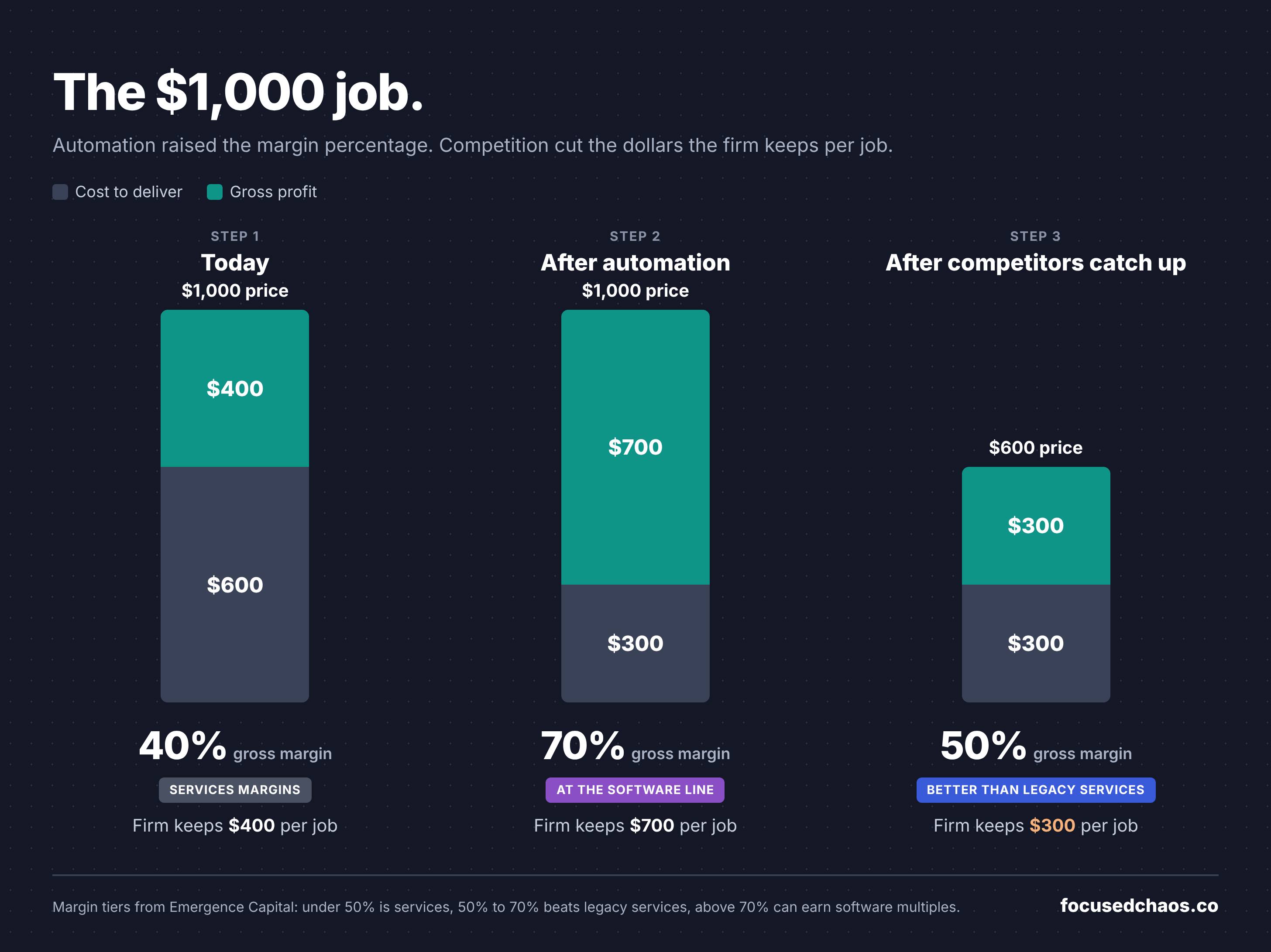
Here’s a hypothetical example.
You charge $1,000 for a job that costs $600 to deliver. You earn $400 in gross margin.
Automation reduces delivery cost to $300.
At the same price, you now earn $700, a 70% gross margin.
Beautiful. Put it in the pitch deck. We’re heading to the moon!
Then competitors improve their automation too. Customers see cheaper options. Your price falls to $600.
You now earn $300 per job, a 50% gross margin.
You’ve cut delivery costs in half, but you earn fewer gross-profit dollars per job than when you started.
You might compensate through higher volume, cheaper acquisition or additional services. The business could still become much better.
But “AI does more of the work” doesn’t establish that you automatically capture more of the value.
This is why the pricing discussion matters so much.
When customers know that most of the work is automated via AI, they’ll probably demand lower prices. A $4,000 manual job is now $400 with AI…but at some point it’s going to be $40.
And if you charge per hour, they’ll expect you to be honest about the number of hours worked. That job that took 100 hours now takes 10. You can’t keep billing for 100 hours.
You gain capacity, but you need more work, higher rates or a different pricing model to preserve revenue.
Fixed fees let you benefit from lower delivery costs, provided you can hold the price. That’s where competition and the customer’s perception of value come in.
Accountability is part of what customers buy
AI-native services companies sell a promise that software vendors often leave with the customer: “We’ll take responsibility for delivering this.”
In regulated industries, that promise requires an appropriate structure.
Harper operates as a licensed insurance agency. Corgi became a licensed insurance carrier in July 2025.
Crosby separates its software company from a lawyer-owned legal practice. Garfield AI received authorization in England in May 2025 as an AI-driven law firm.
These businesses don’t all have comparable economics. A carrier taking insurance risk is different from a broker placing policies. But they illustrate an important point: producing output is only part of the service.
Someone must be qualified to provide it, stand behind it and respond when things go wrong. That creates an interesting tension. Investors want human review time to fall. Customers want confidence that someone competent understands their situation.
Those goals can coexist, but “we use humans to check everything” becomes a difficult promise when improving margins depends on humans doing progressively less.
What happens when a client asks why a recommendation was made?
Can the expert explain it? Can they defend it? Can they challenge the AI? Did they actually review the underlying work?
If the answer is, “let me ask the chatbot that wrote it,” the customer may reconsider what they’re paying for.
The opportunity is to reduce unnecessary effort while preserving useful judgment and responsibility. That’s harder than generating a document. It may also be what lets you hold your price.
What makes AI-native services defensible?
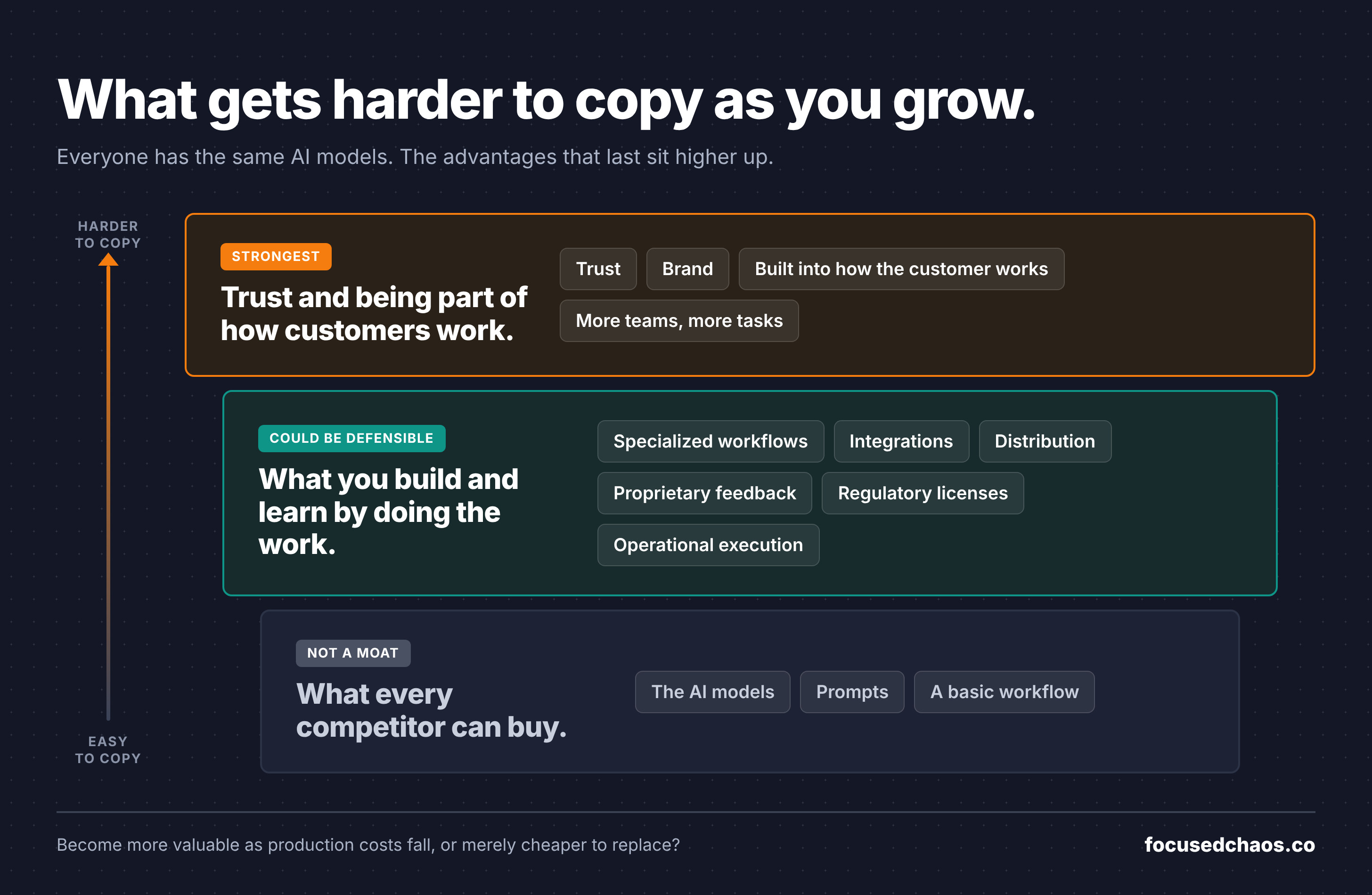
Everyone has access to the same underlying models. That doesn’t mean every provider will perform equally well, but access to those models won’t give you a moat. It’s possible AI-native services companies build their own models, but that’s an expensive and time consuming proposition. I’m not sure customers will care.
There may be advantages in specialized workflows, integrations, distribution, proprietary feedback, regulatory capabilities and operational execution. Some could be defensible…
What gets harder for competitors to replicate as the business grows?
Trust matters. So does becoming embedded in how a customer gets work done. Brand will likely become an increasingly important competitive advantage.
Those advantages could help resist dropping prices and commoditization.
AI-native services need to be sticky: embedding themselves in customers’ work, expanding into other teams and taking on additional tasks where they can deliver reliably.
Expansion needs discipline. If every new service requires another team of experts and a completely different delivery system, you may be adding revenue without improving scalability.
The question is whether you become more valuable to customers as your production costs fall, or merely cheaper to replace.
You need to maintain trust and authority, make the customer’s life meaningfully better (I’d say “insanely better!”) and give them a reason to stay even when someone else offers a lower price.
Incumbents have the same problem, in reverse
AI-native services companies need to prove they can build scalable delivery behind their revenue.
Incumbents already have the revenue, relationships and reputation. They need to prove they can change how they deliver without destroying the business that pays the bills.
Neither is easy.
An established firm that bills by the hour has a problem when AI turns 100 hours of work into 10. The client expects a lower bill. The firm still has people, overhead and partner compensation built around the old business model.
Buying AI tools doesn’t resolve that. Pricing, incentives, staffing and customer expectations all have to move.
But incumbents have advantages that startups are spending heavily to build: distribution, trust and someone customers already call when they need help.
I see three opportunities:
Focus on growth and expansion using AI: Build new businesses and services that are AI-native, going into markets or tackling opportunities that you previously couldn’t do effectively. Big service firms get asked to help with all sorts of things beyond their core competencies. AI could be the unlock.
Disrupt the bottom of the market: Big service firms often can’t go after smaller, cheaper jobs because they can’t deliver the service efficiently and cost-effectively. Those smaller projects that they could never win, or are starting to lose, could be gained through AI-native services or AI-first products.
Add new business models: There’s no reason big service firms couldn’t build software products and sell those to customers. This could be a combination of #1 and #2 above. Service firms build software to replace their services and then change how they charge, leveraging usage-based business models to replace service revenue they’re going to lose anyway. Diversifying revenue streams is a strong defense against disruption.
These experiments need clear ownership and incentives. If every new offering has to protect existing billable hours, don’t be surprised when innovation produces a nicer presentation and very little else.
The question for startups and incumbents is the same: can you keep customers happy while changing the economics of delivery?
Startups don’t win that argument simply by being new. Incumbents don’t win it simply by having clients.
Don’t confuse a good service with a proven venture thesis
I’m optimistic about using AI to deliver better work, faster and at a lower cost.
That’s a compelling proposition. Plenty of incumbents deserve the pressure.
I’m less convinced that early revenue (or even some of the early hyper-growth we’re seeing) tells us which AI-native services companies will become truly venture-scalable businesses. But not all AI-native services have to be venture-backed either. Venture capital is one tool in the toolbox, designed for outlier winners.
A service business with loyal customers, healthy profits and talented people can be a great outcome. It doesn’t need software margins to justify its existence.
The published evidence on AI-native services is still limited. Margin forecasts vary widely, and many efficiency claims come from companies themselves or their investors.
Emergence Capital uses gross margin above 70% as a threshold for software-like valuations. That’s its framework, rather than a universal rule that’s been proven. Hard, judgment-heavy work may have different economics from routine processing.
It’s early days.
I expect we’ll see a lot of successful AI-native service businesses emerge, including smaller ones optimizing work without attempting to scale with venture capital. I expect a lot of the heavily funded companies won’t make it (that’s how venture capital works), especially the ones spending aggressively to acquire customers and establish credibility.
Conceptually, AI-native services make sense. Delivering value faster at a lower cost works for specific types of jobs. You need the right jobs, customers and frequency for the math to work.
Please celebrate the first invoice. I know from experience how hard it is to get, and how great it feels. Celebrate the renewal too!
Then dig deeper to truly understand what’s going on.
Are customers returning because you deliver real value? Is there enough differentiation to keep those customers without a race to the bottom? Is delivery improving without quality falling apart? When do you risk customers being turned off by “too much AI?” Are you keeping enough of the efficiency gains to build the business you’ve promised?
AI-native services aren’t as easy to build as they look. They may be reasonably easy to get off the ground, but scaling them is another story.
Great stuff, Ben. Actually, I am advising an AI-native bookkeeping company. What this startup drastically underestimated is (1) how hard it is to make customers change their behavior (i.e., using the AI services and NOT emailing the CS reps), and (2) what kind of customers they attract. In this case, they chose the startup so that their bookkeeping mess is cleaned up for a small fee. We've seen quite a number of customers who cancelled after the mess was cleaned up (with a lot of human work).