
How I'm Pricing an AI Product
The real costs, uncomfortable margins and live experiments behind an AI pricing model.

AI pricing is a mess.
Companies are changing their pricing every six months. Buyers don’t know what they’ll pay, how to budget, or whether all the AI being stuffed into products is creating enough value to justify the cost.
What’s going on?

The market is moving away from traditional seat-based pricing toward usage- and outcome-based models. But we’re stuck in the messy transition: companies are changing their products and business models simultaneously, while customers are being asked to absorb unfamiliar, and often unpredictable, ways of paying.
I’ve been working to figure this out, because we’re launching Candor, a synthetic user research product we’re building at Highline Beta, and we need a business model. That means instrumenting the real costs, researching the market, building a model and putting it in front of potential customers.
Here’s what I’ve learned so far…
AI Changes the Cost Structure
Classic SaaS had one huge advantage: adding a customer cost almost nothing. Add a seat, print money. That’s why per-seat pricing worked and why margins sat at 80-90%.
AI breaks that. Every action a user takes burns real tokens, so cost scales with usage instead of staying flat. Bessemer pegs AI-first companies at 50-60% gross margins, not 80-90%. Ben Murray, the SaaS CFO, put it well: “If SaaS is about margin efficiency, AI is about value density.”
Two things follow:
A flat monthly fee plus a heavy user can mean you lose money on your best customer.
Per-seat pricing leaves money on the table when one person with AI does the work of three, and you end up selling fewer licenses.
No surprise seat-based pricing is shrinking (21% to 15% of companies in a year) while hybrid models climb.
I wrote about this in Lean Analytics, Reconsidered. Now I’m living it.
First: Do Your Research
Before I touched Candor’s pricing, I did my homework.
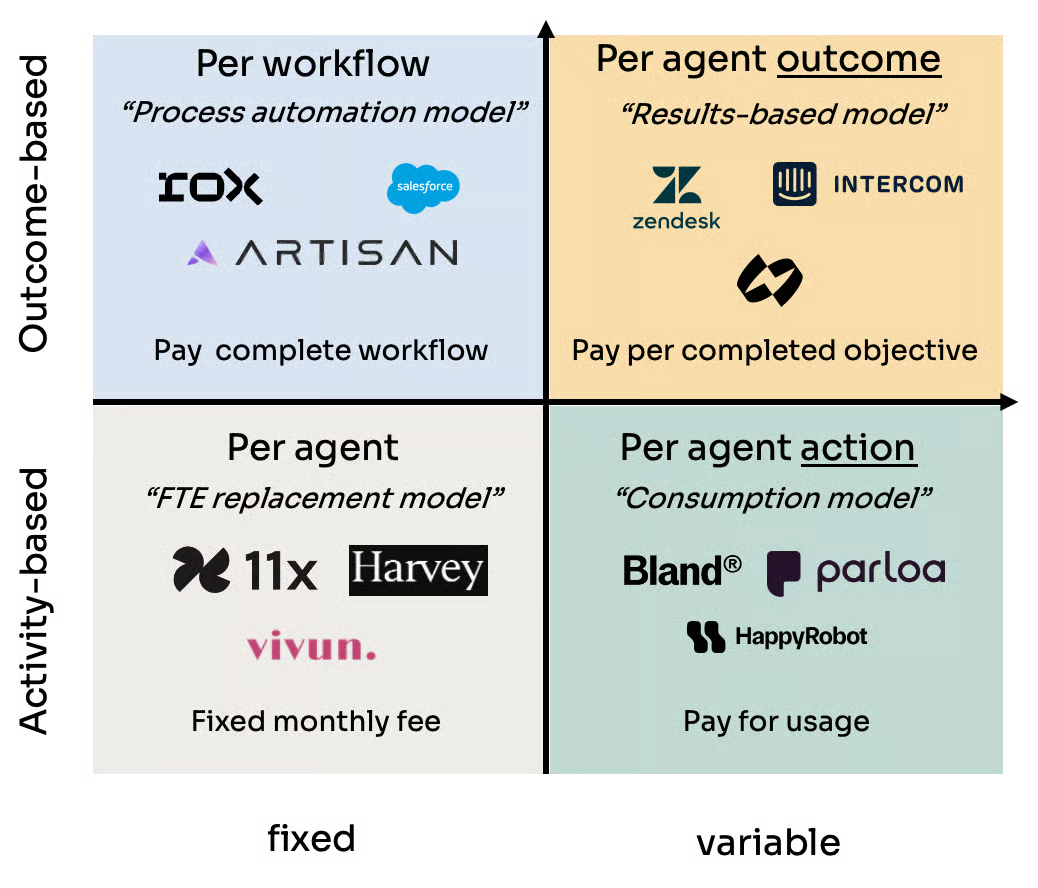
The clearest thing I found is Kyle Poyar’s Growth Unhinged, specifically Manny Medina’s framework for AI agent pricing built from 60+ AI companies. He breaks it into four models: price per agent (the “replace an FTE” model), price per action (consumption), price per workflow, and price per outcome. Each has a different upside and a different way to get you killed. Per-action is transparent but commoditizes you. Per-outcome aligns you best with the customer but is hard to attribute. Here’s a diagram they put together:
a16z has been beating the outcome-based drum for a while too. The most quoted example is Intercom’s Fin, priced at $0.99 per resolved conversation. You pay when it works. Fin was recently acquired by Salesforce for $3.6 billion dollars, so something must have been working! 🤑
I mentioned Kyle Poyar above, but want to highlight his research and writing on this topic:

Do your homework, but recognize that AI pricing is a moving target.
Cost Sets the Floor, Value Sets the Ceiling
I never wanted to price Candor on what it costs to run. Customers don’t care about my token bill. They care about getting sufficient value to justify the price.
But “price on value” is only half the battle. Here’s the fuller version I actually worked with: cost sets the floor, value sets the ceiling, and customers tell you whether you got it right.
Cost is the floor. A Candor interview costs me around $2.50 all-in. I can’t price below that. But cost doesn’t decide the price. It just tells me how low I can’t go.
Value is the ceiling. If a study saves someone days of work and stops them from shipping the wrong thing, it can be worth thousands of dollars to them. Maybe more. But that value has to be proven. And it may not come in one study through Candor, it might be several. Ultimately, people will pay what they think it’s worth, so value is the top of the band.
My job is to pick a number above the floor and below the ceiling, then watch what people actually do. Behavior is the referee. You don’t really know if you read the value right until customers buy, use, upgrade, or churn.
One caveat: I meter interviews, but an interview isn’t the true unit of value. What the customer values is the finished study, the synthesis, the decisions it drives. The outputs leading to the outcomes. The interview is just the cleanest thing to count that still scales with that value. It’s a proxy, and there’s risk in confusing the proxy for the value itself.
Candid about Candor
Here’s what I landed on to start:
$75/month for the platform and 5 active project slots
$7 per automated interview
$10/month for each additional slot beyond the first five
This is the Standard plan, publicly available on the pricing page.
A project is one audience: ~24 grounded synthetic personas you can interview as many times as you want. One interview is one automated conversation with one persona. Auto-interview a 24-persona audience and that’s 24 interviews, so $168 on Standard.
The interviews are where the cost and the value (for the most part) both live.
Generating an audience has a real token cost (covered by the monthly fee), but it’s the interviews, especially re-interviewing the same personas, that rack up usage.
That’s the whole reason it’s per-interview. If I fold unlimited interviews into a flat fee, a power user running hundreds of them would torch my margins. The alternative is guessing usage and stacking tiers (Standard, Pro, Enterprise) with overage math on top. I wanted to keep it simple.
The project slots keep the base fair. Five projects are included. Archive one (it stays viewable) to free a slot, since an idle project costs me nothing. Even if someone spins up all five on day one, there’s still a little margin in month one and more every month after, because audience & persona generation is a one-time hit. Extra slots at $10/month might lose me a bit up front and pay off later.
So Candor is a hybrid: a low platform fee for access, plus consumption pricing on the one unit that carries both cost and value.
In Medina’s language, mostly per-action with a small platform base. I’d like to push it toward outcome-based over time, but “we ran a study that changed our decision” is harder to meter than “we ran an interview.” Baby steps.
Your Costs Move Every Time the Model Does
I recently upgraded Candor from Sonnet 4.6 to Sonnet 5. It’s faster and the insights got better, exactly what I want for customers. But it also burns 25-35% more tokens in my testing. That lands straight on my margins.
Every model upgrade is a pricing decision in disguise. Swapping models sounds great in theory, but you have to understand the implications to how your product works and your costs. Quality may not always go up with a new model. Costs may not go up either, but you won’t know until you put the model in and run it through its paces.
In Candor’s case, I was able to absorb the additional token usage in my price (and worked on more robust caching), but costs definitely went up.
The Tightrope: Inexpensive Enough to Try, Priced Enough to Matter
Price too low and people assume it’s a toy. Price too high and you never get the conversion, so it doesn’t matter how good your margins would have been.
And “too low” isn’t just a vibe. Venture Curator looked at retention across roughly 3,500 software companies and found AI products under $50/month retain terribly: about 23% gross retention, versus 45% in the $50-249 band and 70% (basically healthy SaaS) above $250. Cheap AI doesn’t only look like a toy. It churns like one.

I think part of the reason AI tools are seeing such high churn is because people are making a “build versus buy” decision. If your AI tool is $19.99/month, I gotta believe I can clone it quickly and feel like I’m paying nothing for it.
That’s a real risk for Candor. At $75 my base sits in that middle band, not the safe zone. My bet is that usage pulls effective spend up and ties it to value: a serious user spends well past $75, and every dollar is attached to research they chose to run. The failure case is the light user who pays $75, runs a couple of interviews, and drifts.
On the market, looking cheap isn’t my worry. The synthetic research tools I checked cluster in a $20-80/month self-serve band (Viewpoints, AskRally, Delve, Deepsona), but can scale up easily to $500/month or more. Many of them have “quote-only enterprise versions” as well. I know a couple tools have enterprise licenses in the tens of thousands of dollars range.
At $75/month plus usage, an active Candor account starts self-serve and climbs toward enterprise. If anything the risk runs the other way: a heavy month lands closer to enterprise money than a self-serve buyer expected.
Then I Launched a $0 Plan
Everything I just said argues for having a defined minimum price. So naturally, the next thing I did was launch a free plan. 😜
This came directly from feedback. I put Candor in front of potential customers who don’t run much research. They’re interested and would use the tool now and then, but $75 a month for occasional use tough. The subscription was the barrier, not the per-interview price.
So I’m testing a free plan. It’s really pay-as-you-go: $0 a month, 2 project slots, and you only pay when you run automated interviews. The catch is usage costs more, $10 an interview instead of $7, and $15 project slots instead of $10. I took the money out of the subscription and moved it into usage.
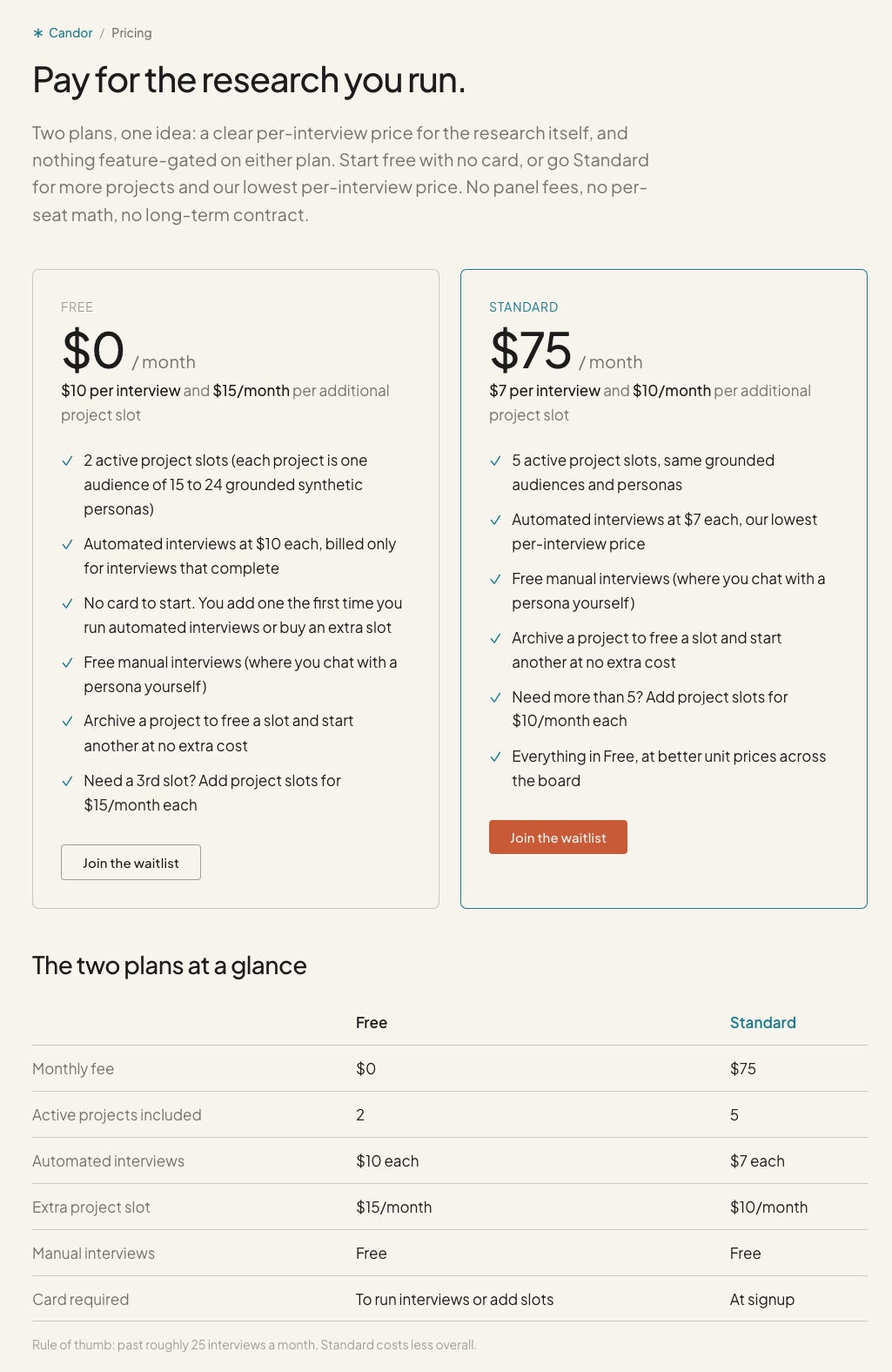
Does that contradict the churn warning? We’ll see. The data on high churn rates is focused on flat subscriptions people forget and cancel. Pay-as-you-go has no subscription to churn out of, and no monthly line item quietly asking “do I still use this?” If a customer goes quiet, I don’t lose revenue, because there wasn’t any until they ran research. The risk isn’t churn, it’s inactivity, and some of that just means they weren’t my customer to begin with.
Note: I’m not convinced the Free plan will survive and make sense for my ICP (Ideal Client Profile). I need to test the ICP more and sharpen it as I go along. The occasional researcher may not be a great customer.
The two plans are designed to quickly sort people. Here’s the monthly bill at steady state, once the slots are generated:
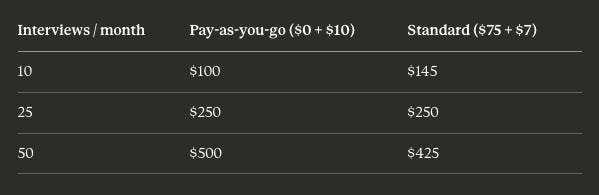
They cross at about 25 interviews a month.
Below that, pay-as-you-go is cheaper for the customer but Standard is better for me (that $75 does a lot of work at low volume).
Above it, Standard is cheaper for the customer but a pay-as-you-go customer is more profitable for me ($10 an interview instead of $7).
So a light-research user picks Free, a heavy one picks Standard, and I’m happy either way. The pricing does the sorting.
Ultimately, this is all a test. Synthetic research is still a relatively new concept, and a $0 door might be how people try it, see value, and upgrade. Or it might just pull in free-riders. I don’t know yet, which is exactly why I’m running it live instead of arguing about it in a spreadsheet.
The Free Trial & the Real Cost of Acquisition
Before anyone picks a plan, they get a free trial: one project, one full run. Build an audience, interview it once across all the personas, see a real report. No credit card, no charge.
That trial isn’t free to me. A full run costs about $68 (a 24-persona audience generated and interviewed once, plus synthesis). I eat that on purpose. Synthetic research is easier to show than to explain, so I’d rather spend the compute letting someone watch it work than write another paragraph promising it does.
If they then move to the Free plan and spin up a second audience, that’s another ~$9. So I can be roughly $77 into a customer, in hard costs, before I earn a dollar.
I’ll call that hard-cost acquisition, not full CAC, because it leaves out sales and marketing. But it’s the part people miss when they stare at gross margins. My interviews may run 60-85% margin, which sounds like a healthy business, right up until you remember I paid $68 to $77 up front for plenty of people who’ll never convert. The number that decides whether Candor works isn’t interview margin. It’s what a customer spends over their life versus what it cost to acquire and activate them.
So I’ll be watching the funnel in stages:
The cost to get a free-trial signup
The % who actually run a study (add ~$68 in costs)
The % who churn and just cost me money 😓
The % who move to Free (add ~$9 in cost to generate a second audience)
The % who move to Standard (up to ~$36 in cost for their extra slots)
On a single-customer basis those hard costs are manageable. Blended across real conversion rates and actual marketing spend, I genuinely don’t know yet. That’s the number I’m most nervous about.
You Can Check Out the Math
I decided to share all the math in a public model you can dig through.
If you’re pricing an AI product, you probably have something similar. Probably more robust. But if my model is helpful to anyone, that’s great.
I also think transparency in the AI world matters. I don’t expect all of Candor’s customers to view the spreadsheet and analyze costs vs. price vs. value, but I don’t need to shy away from it either. The tiers and logic aren’t arbitrary. If sharing the model encourages a broader conversation around Candor, Candor’s pricing and Candor’s value creation, I’m all for it.
Where I Think This Goes
One prediction: we’re going to see real pressure on high flat monthly subscriptions, and a growing willingness to accept usage-based pricing, even when the total bill ends up higher.
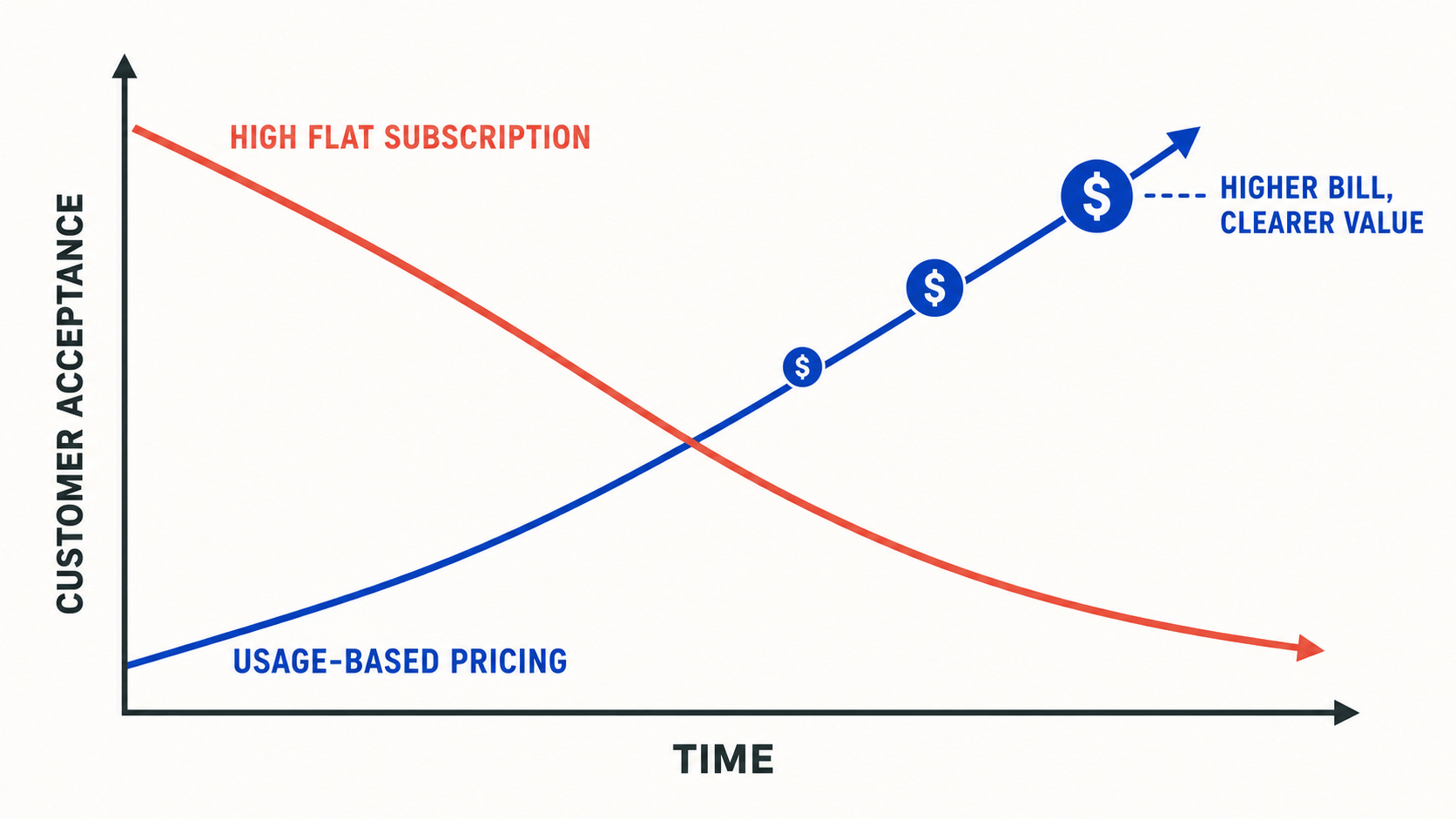
People don’t hate spending money. They hate spending money with no line of sight to the value. A $500 flat fee per month with no idea what you got feels worse than $700 of usage where every dollar points at something real. Usage-based pricing, done right, is just honesty about what you used and what it was worth.
If that’s right, the winners won’t have the lowest sticker price. They’ll be the ones that tie price to value so cleanly that spending more feels good, because you got more.
Recommendations for Pricing AI Products
Here are 5 recommendations for pricing an AI product based on what I’ve learned so far:
Instrument your costs before you price. You can’t price an AI product you haven’t measured. Know what each action costs you, including the invisible token spend (retries, reasoning, agent loops). If you can’t see it, you don’t know your margin.
Find the one unit that carries both the cost and the value, and meter that. For Candor it’s the interview. For you it might be a resolution, a workflow, a generated asset. Price the thing that scales with value, not the thing that’s easy to count.
Keep the base low for access, but not so low it churns. Make it easy to start, then let usage pull real accounts above the danger zone (cheap AI churns like a toy). Your heaviest users should be your best accounts, not your worst.
Let cost set the floor and value set the ceiling. Price well above what it costs you and below what it’s worth to them, then let customer behavior tell you if you guessed right. Cost is a constraint, not the target.
Expect to revisit it. Model costs move in both directions (a better model can cost you more, not less), usage patterns will surprise you, and your first guess will be wrong somewhere. Pricing is a product you keep shipping. Frequently.
Pricing is a product decision now, not a finance afterthought. That’s exactly what’s happening with Candor.
If you’ve priced an AI product, I’d love to know: what did you meter, and what did you get wrong the first time?