


We’ve reached the stage where AI writes the document and AI reads the document, and the human in between is optional.
You’ve probably experienced this already. Someone feeds a pile of analysis into a model, writes a long prompt, and out comes 22 pages. The recipient opens it, sees 22 pages, and does one of two things: skims it and moves on, or drops it into their own AI and asks for a summary.
Machine generates. Machine consumes. Two humans exchange the illusion of work.
None of this is a new observation. Merriam-Webster made “slop” its word of the year for 2025 (sigh). But I’m living this on a regular basis now and starting to push back.
If a document needs instructions, the document is broken
We recently wrapped a client engagement that required a series of strategic briefs. Deep topics, real analysis behind them.
AI loves this work. You feed it everything, write an extensive prompt, and it kicks into high gear. At first glance it looks fantastic.
Then you realize every single brief opened with a section called “How to read this document.”
I laughed the first time. By the third one I stopped laughing. If your document needs a manual, your document is broken. Nobody wrote a “how to read this” section when they had to type the whole thing themselves, because the cost of writing forced you to decide what mattered.
That cost is gone. So nothing gets cut, and the job of figuring out what matters lands on whoever opens the file.
People aren’t reading basic product instructions, let alone the manual
Here’s another example that I’m dealing with right now.
We’re piloting Candor, our synthetic user research platform. When a user builds an interview guide there’s an optional field called “Project Context.” The label says: “Add more context on anything specific you’re trying to learn from this interview.” There’s a one-line example sitting right in the field.
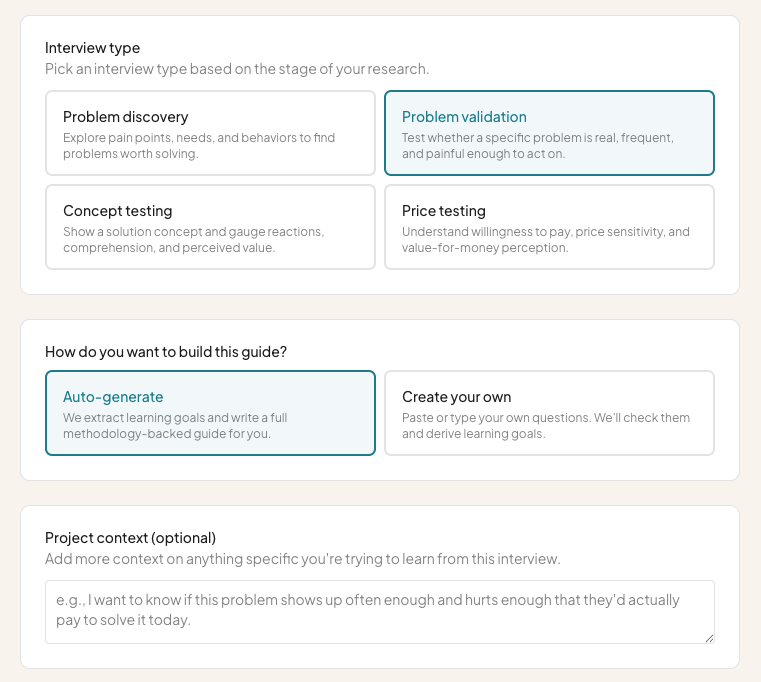
Multiple users have pasted hundreds of words in there. Persona behavior rules. Questions they want asked. Formatting requirements. In one case it read exactly like what you’d get if you asked ChatGPT, “I’m using a synthetic research platform and need to provide it with project context.”
They didn’t read the label, or the example sitting directly beneath it. They asked an AI what to put in a box, and pasted the answer.
Now, before I get too righteous: people never read. Jakob Nielsen measured this in 2008 across 45,000 page views and estimated users read about 20% of the text on a page. That’s not new.
What’s new is that the 80% they skip is now infinite, and they’ve got a machine to write their half of the exchange too.
Provenance tells you which machine, not whether anyone thought
Anthropic just started marking Claude’s output: an invisible watermark in the text itself, plus C2PA provenance on files.
Directionally, fine. But read what a detected mark actually tells you. That the content “may have been processed by Claude.” That’s it.
So a 3,000-word report the model wrote from a one-line prompt carries the same mark as a paragraph I wrote myself and asked Claude to tighten. Those are not the same act. AI-generated is verbose and hard to wrangle into something good. AI-edited means I brought the thinking and the structure, and that’s closer to spell check than authorship.
Which is the problem with provenance as an answer. It tells you which machine touched the words. It can’t tell you whether a human did the thinking.
Honestly, at this point we should be watermarking the human stuff. It’s rarer.
The more you can make, the more people want you to
Once you can produce a strategy deck in four minutes, the expectation becomes that you produce more decks. Not better ones. More. Volume is the only thing anyone can measure at a glance.
That’s the Catch-22. The faster you generate stuff, the more you’re asked to generate, and the less time anyone has to read any of it. This is true of documents, code or anything else.
Researchers from BetterUp Labs and Stanford’s Social Media Lab call the result “workslop”: work that looks polished but has no substance, so the recipient does the thinking the sender skipped. 41% of workers say they’ve received it. Each instance costs about two hours to sort out.
Cory Doctorow puts it more bluntly. Sending someone unverified AI output, he writes, “is an attempt to coerce a stranger into unpaid labor on your behalf.” I love this line. Hysterical, annoying and depressing all at the same time.
Content producers are turning off their brains and asking recipients to keep their brains on. Why should they?
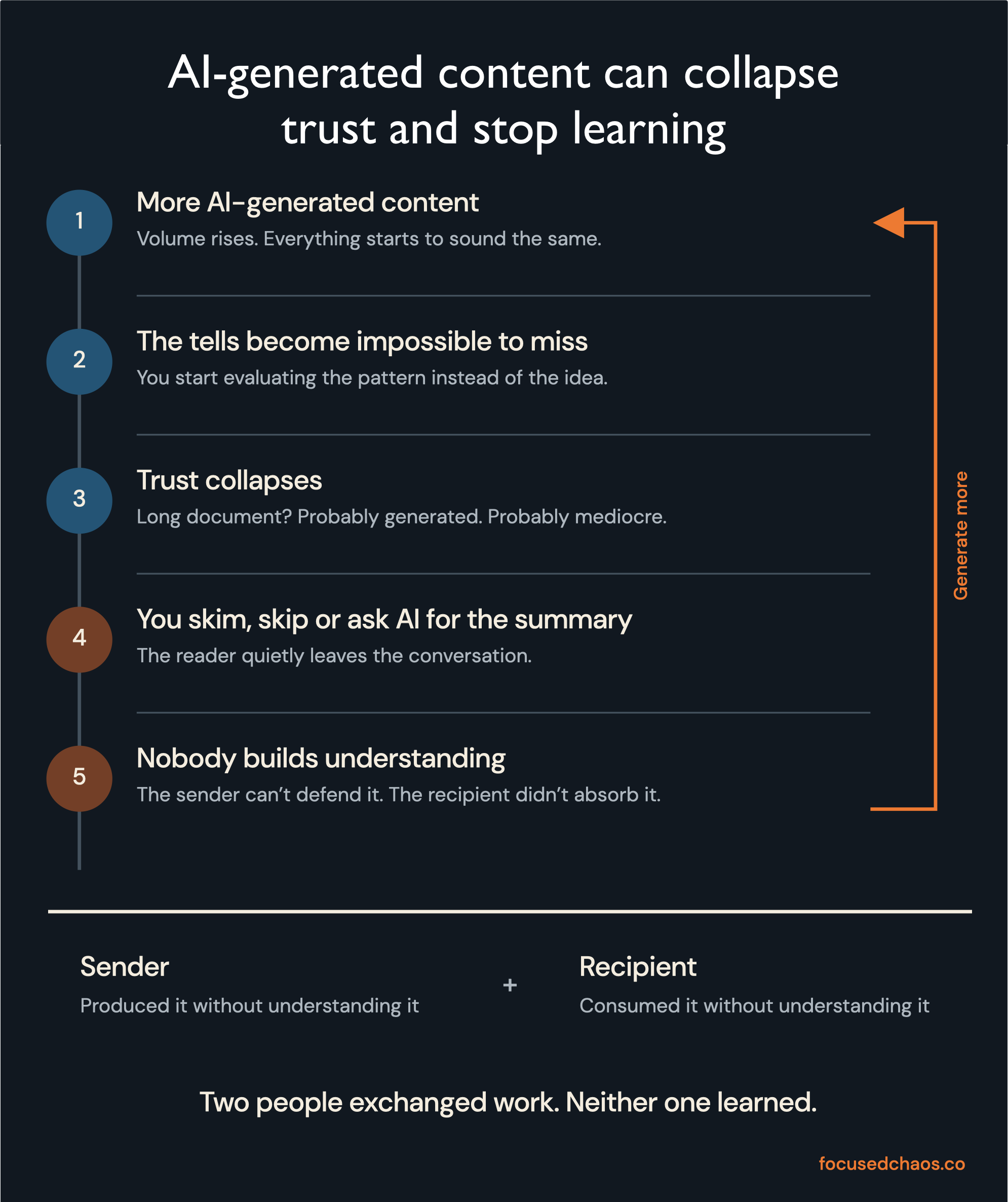
When everything is AI-generated trust collapses and no one learns
So where does all of this end up? Here’s my experience, and I’m sure others are there too:
The more AI-generated content you read, the more you see the tells. Even when people try to hide them.
The more tells you see, the more jaded you get about anything you’re asked to read, review or look at.
The more jaded you get, the more you skim, or skip, or hand it to your AI for the summary.
The more you do that, the less you learn from any of it.
Then you ask follow up questions or challenge the sender, but they’re incapable of answering because they didn’t create the work in the first place. They ordered it. Now we have two people that aren’t learning.
In the end, you start assuming everything you’re sent is mediocre. You see a long document and think, “AI generated. Probably garbage.” You start assuming you and your AI could have produced the same thing in four minutes anyway. You might be right.
This is now a product design problem
If people won’t read a one-line field description, what do you think happens to your onboarding, your tooltips, your product tour, or your docs?
Pew tracked 900 US adults across 69,000 Google searches. When an AI summary appeared at the top, people clicked through to an actual source 8% of the time. When there was no summary, 15%. The summary roughly halved the number of people that clicked into anything to dig in further. And only 1% clicked a link inside the summary itself.
In the relatively short time we’ve had LLMs to engage with, we’re already seeing a re-trained expectation. People want answers immediately, with no exploration and no reading. Then they bring that expectation to your product, which is a tool they’ve never used, doing something they don’t yet understand. If they don’t get value out of your product quickly enough or decide they can just ask their own AI for the same thing, you’re cooked. Incidentally, this is why I think time to value is collapsing and churn is increasing for AI products.
AI makes building much easier, but doesn’t make it easier to build the right thing for the right market. AI building can’t keep up with changing expectations, where users and customers decide they don’t need to read anything, they have no time to learn and they just want everything done for them magically. AI is not magic. Software is not magic.
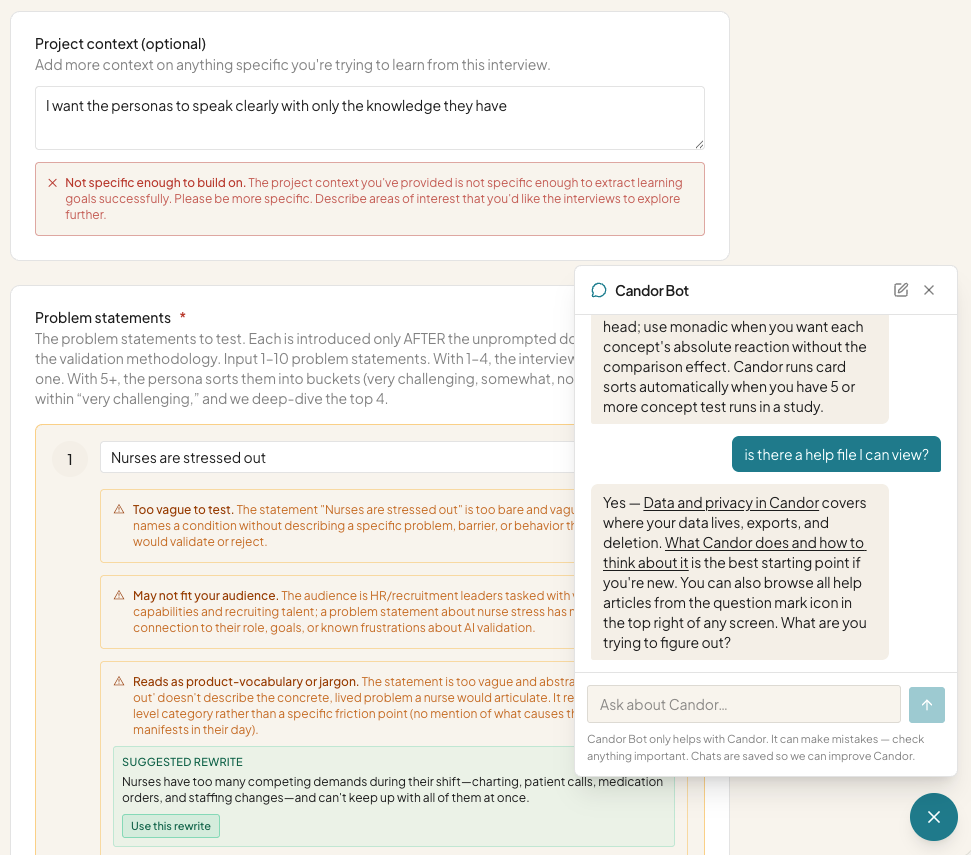
Back to Candor. We stopped asking how to explain inputs better. Better copy doesn’t help someone who isn’t reading anything. Instead, we’re building comprehensive quality checks on input fields. For synthetic user research the inputs are critical, you have a very real “garbage in → garbage out” situation. We’re already seeing challenges with this: someone designs a study with bad or mediocre inputs, they get so-so results and question the value of Candor. I know Candor works, it’s my job to help others use it properly.
We’ve also implemented Candor Bot, a chat interface that knows how Candor works, has built-in best practices, and can read the context of your inputs. I don’t know if people will use it (everyone has “app chat fatigue” while they chat endlessly with LLMs) but it’s an attempt to embed real-time help into the application.
Here’s what I’ve learned:
UI/UX is changing quickly. At some point I suspect most software UIs will be replaced by MCP servers / APIs integrated into a person’s AI interface of choice. People barely want to log into different software products any more. But that’s a discussion for another time.
LLMs have set an expectation of instant results. If your product takes a few minutes to do something or explain something, you might be in trouble.
People are trusting LLM output a lot, in an effort to move faster and feel like progress is being made. They’re blindly copying & pasting things everywhere, whether it’s a report or into an input field in your software product, without stopping to think.
The reality is that you’re no longer designing for a user. You’re designing for a user plus their AI, and the AI is going to do more and more of the work.
What I’m telling our team
AI is good! AI is bad! AI is… 🤬 🤨 😢
I’m not interested in raging against the machine. I want to wrangle the machine to do what I need and help others do the same. The more I produce and consume “workslop” and see how people interact with Candor, the more I’m encouraging the Highline Beta team to take certain actions.
Write it yourself first, then use AI to edit. Not the other way around. The quality isn’t close, and you can’t defend something you didn’t think through. The pull to go the other direction is enormous. Resist it.
Ownership matters. Whenever you send something to a client, prospect or anyone else, you are responsible for it. You own the thing you sent, whether you produced it or not. That ownership means you now stand behind what was produced and sent. Tough to do when AI wrote it all.
Define “done” before you generate. I do this when building software with Claude Code: three to five pass-or-fail checks written down before any work starts. Same for a document. If you can’t say what good looks like in advance, the model will happily hand you 22 pages of not-that. A smaller version of this: write out the sections of the document, why you need them, what they should contain and how you expect them to link together. Better prompting (to some extent) can wrangle AI to produce better quality.
Treat length as a cost you’re imposing on someone else. If your document needs a “how to read this” section, cut it in half. Then cut it again. Editing is critical, but not if your eyes glaze over and you’re going through the motions.
Be ready for follow-ups. We don’t send things to clients hoping they file them away and ignore them. We want them digging in, asking questions, challenging us and connecting dots. We have to be prepared for that. If we can’t do that, we’re not doing our jobs.
Design for people who won’t read. Content needs super clear summaries that are actionable. Software products need to assume people skip all instructions and just copy & paste AI generated stuff into them. Think about how our output can do more of the work and make it easier for recipients to digest, learn and action things quickly.
Outsourcing to AI is the wrong way to think about it
We talk about outsourcing work to AI as if we’ve handed responsibility to another person. We haven’t. AI can produce the output, but it can’t own the outcome.
Most of the code in Candor is written by AI. But I decide what gets built and why. I evaluate the work, test it, change direction and ship it. If Candor sucks, it’s not the AI’s fault. It’s mine.
The same applies to everything we produce at Highline Beta. Clients don’t care whether AI helped generate a report. They care whether it’s precise, useful and worth what they paid for. They care whether we can explain the thinking, answer their questions and help them decide what to do next. Six hundred slides nobody has time to consume isn’t value. It’s output masquerading as progress.
That’s the distinction we’re losing. AI makes it easy to produce something and mistake that act for finishing the work. But generating is only the beginning. The work isn’t done until you understand what was produced, know why it matters and can defend it.
Delegate production. Accelerate execution. Use AI aggressively. But don’t delegate judgment or responsibility.
AI naturally leans toward more output. Humans need to stay focused on better outcomes.
Produce less. Mean it. Be able to defend it. 💪
I keep catching myself treating generation as the work.
The practice I would actually keep is writing three to five pass/fail checks before anything gets generated. If I cannot name those, I am not ready to hit go. Twenty-two pages is what you get after skipping that step and still calling it strategy.
Hey - part of this post doesn’t make sense. You’re saying don’t put out AI crap - sensible argument. But from there on you diverge and say that for content you have to write it yourself and get AI to polish it. And for code the other way around; which doesn’t make sense. A crap article is very similar with a crap piece of software from that perspective - things people don’t want to read/use cause they don’t make sense. So the method doesn’t really matter.