In medieval warfare, sieges were often decided by sheer volume. An invading army would throw thousands of soldiers at fortified walls. Casualties were obscene. Most died before they got close. But occasionally, someone made it over.
That’s what pre-seed investing feels like right now.
And if you’re thinking: didn’t Gandalf show up at Helm’s Deep and save the day? Sure. But that’s Lord of the Rings. This is real life. VCs love to think of themselves as Gandalf-level awesome. They’re not. Nobody’s riding in at dawn with the Rohirrim to save your startup. You’re going to have to break through those walls yourself.
The barrier to starting a company has never been lower. AI coding tools, AI GTM tools, AI everything tools means you can get from idea to functional product in days. So founders are launching. Lots and lots of founders. Throwing their startups at the wall to see what breaks through.
Cannon fodder.
To be clear: I’m not being dismissive. I’ve written before: we need more founders. More entrepreneurs, not fewer. Small businesses employ nearly half the private sector workforce and generate enormous amounts of economic value. More startups means more shots on goal, and some of those shots will matter enormously.
On the investor side, I’ve also argued that we need more angel investors to fund the next generation of founders. Someone has to take the earliest bet…
So yes. More startups. More investors. More entrepreneurship. 💪
But there’s a signal-to-noise problem right now that I’ve never seen before. If you’re trying to invest at the pre-seed or angel stage, you feel it constantly.
Here’s how I’m thinking through these challenges…
1. The “Why” Matters More Than Ever
The ease of starting a company means founders don’t always have a great reason for doing so. They see opportunity. They think they’ll win fast. They’ve read the stories about AI companies hitting millions in ARR within months of launching and they want some of that. It feels a bit like the dot com era.
Of all the things you could be doing with your life, why this?
That question matters more in a cannon fodder environment. Founders building because it’s cool, or because the timing seems right, or because they’ve spotted a gap from the outside, are the ones getting mowed down. Founders with a genuine insight, born out of lived experience or deep domain expertise, have a different quality of conviction. Conviction is what carries you through the grind.
Ed Sim from Boldstart, who’s been investing at the inception stage (his preferred term for pre-seed) for many years, describes the founders he backs as being on a mission. They can’t stop thinking about it when they wake up in the middle of the night. That’s the bar.
Founders: Using AI Aggressively is a Requirement
The use of AI tools to build and operate your startup is now table stakes. Not a differentiator. Table stakes.
Ed frames this as a direct question he now asks every founder: how much of your code was written by agents? His expectation for a software company is close to 100%. But it doesn’t stop at code. It’s product marketing, GTM, research, operations. The entire company needs to be agent-native.
What I’m looking for beyond the basics is creativity in how founders are using AI to innovate on startup creation itself. Not just building the product faster, but reimagining how they go to market, how they serve customers, how they operate. Founders who treat AI as a weapon rather than a utility.
Speed of execution matters more than ever because differentiation is compressing fast. But speed alone doesn’t win anymore either. Necessary condition, not sufficient.
One of the things I genuinely love about where AI is taking us: it’s opening the door for all types of entrepreneurs to build all types of things. Not just VC-scale swings with giant exit ambitions. Side hustles. Lifestyle businesses. The person who wants 50 paying customers a month to generate $5K in recurring revenue and buy back some freedom. That’s legitimate. That’s valuable. AI has made it more achievable than ever.
But if you think a lower bar is easier, you’re in for a world of hurt.
Getting 50 customers consistently is hard. Keeping them is hard. Distribution is hard regardless of your revenue target. Traction at any scale requires repetition, discipline, and more iteration than most people expect before they’re in it. The rules of building a real business don’t soften just because you’re not chasing a Series A.
Please: build the side hustle. Build the lifestyle business. Not everything has to be a moonshot, and frankly the failure rate on moonshots is brutal. But go into it with open eyes. “I don’t need to raise capital” is a feature, not a shortcut.
The Moat Problem
People are panicking because the moats they once held dear are drying up.
Network effects? Sometimes. Data advantages? Possible, but hard to prove early. Technical differentiation? Compresses in days, weeks, months. Ed Sim put it bluntly: what used to take 12 to 18 months to replicate in software now takes a fraction of that time.
Let’s not forget, moats (or ditches and walls) in medieval times weren’t perfect either.
The siege of Château Gaillard in 1203–1204 is a classic example. Built by Richard the Lionheart, it was considered nearly impregnable, yet it still fell to Philip II of France. After months of conventional siegework, French troops ultimately exploited an unguarded latrine shaft leading into the chapel and climbed through, opening the way for the castle’s capture. When someone is determined enough, they find a way. Moats and walls bought time. That’s it.
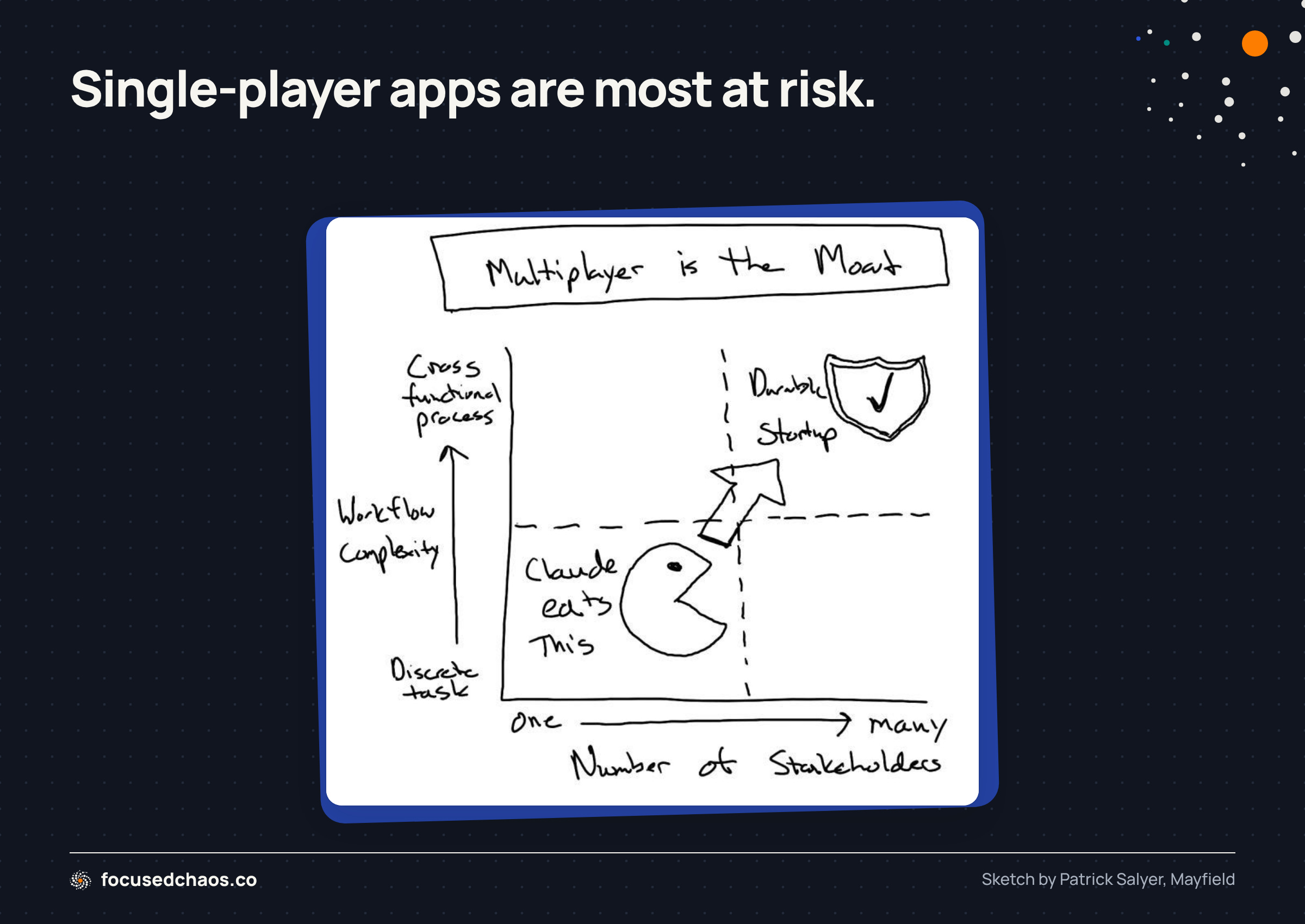
“There’s a simple filter I’m starting to use when evaluating AI agent startups: single-player or multiplayer?
Single-player AI apps are most at risk. They handle discrete tasks with limited complexity, exactly what Claude is designed to do incredibly well today.
Multiplayer apps require collaboration across multiple stakeholders to complete complex workflows. They need human-in-the-loop engagement, governance, and security around who can access what. Multiplayer is the moat.”
That maps to something Ed talks about too: the investments that hold up have domain complexity that can’t be collapsed into a single skill or replaced with the next model release.
Rob May, who writes Investing in AI (which you should read) argues that “weird stuff wins.” His take: the only durable opportunities might be genuinely low-probability and out-of-distribution. Ideas that don’t show up in training data patterns. Things that require real information asymmetry to even recognize as opportunities. As AI makes marginal innovation obvious and replicable, the success distribution shifts toward the weird ideas. It’s a provocative take, but there’s something real in it.
Which brings me back to what I think might be the last genuine moat: what does the founder know that nobody else does?
A proprietary insight developed through years in an industry, or a specific pain they’ve lived through, that gives them an unfair head start. That’s the question I come back to most in early-stage meetings.
Go narrow first, then scale
There’s endless debate: start in a niche or go for a platform play immediately?
My vote, most of time: start narrow
Insights come from going narrower. Finding complex problems comes from going narrower. The deeper and more specific you go into a market, the higher the likelihood of finding something that actually matters. You may uncover some boring problem that 10,000 other startups aren’t already chasing.
Founders: Please Don’t Pitch at the Pre-seed Stage with Only a Deck
If you can ship an MVP in days using AI coding tools, and generate early demand signals using AI GTM tools, then showing up with just a pitch deck sends one clear message: you haven’t done the things you could have already done.
Pre-seed and angel investors want to see a functioning product. An early waitlist. Some proof that someone out there cares. That doesn’t have to be hyper-growth. But you need to demonstrate two things: (1) that you’re creating real value; and, (2) that you know how to reach your market.
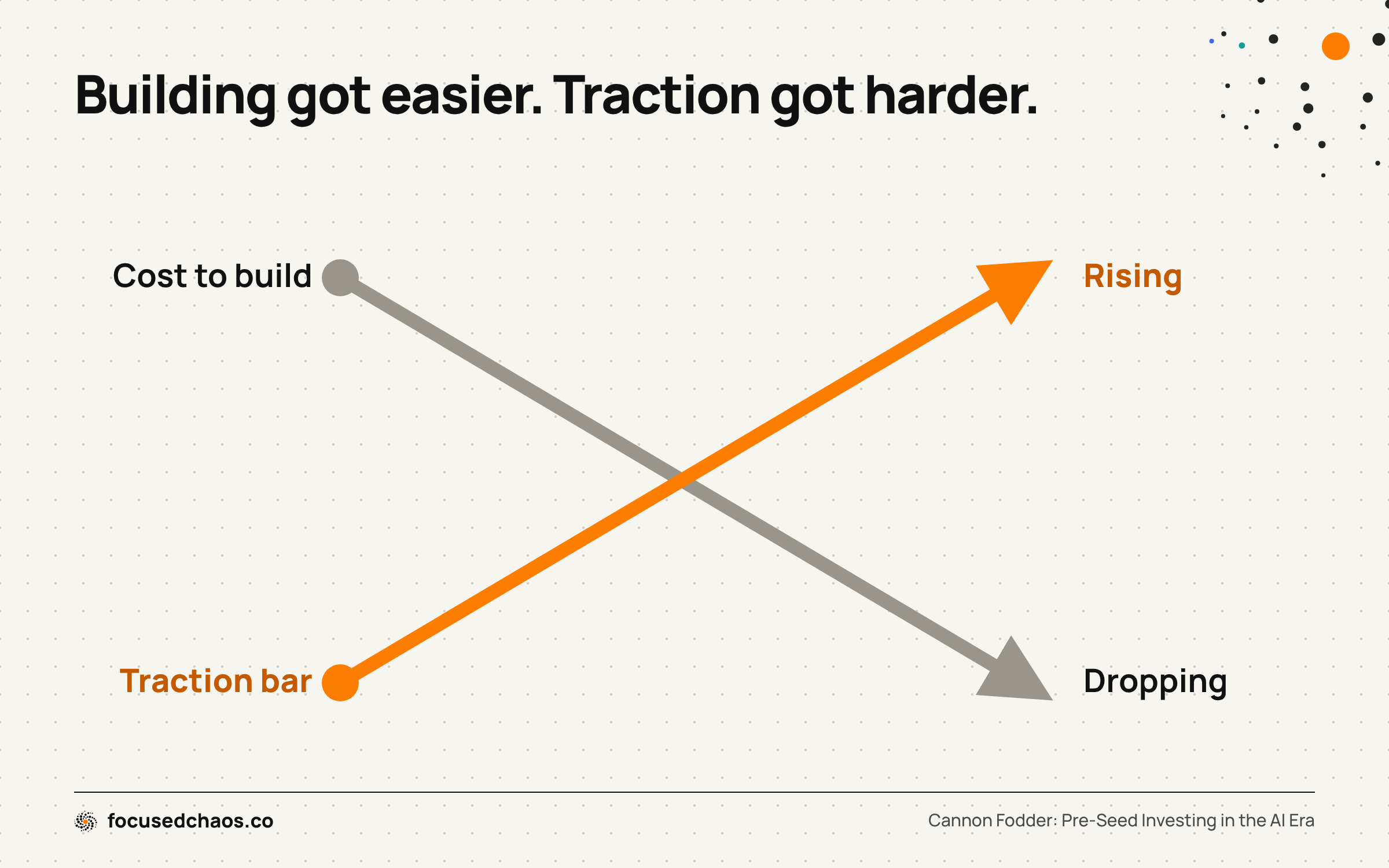
The bar on traction has gone up, because the bar on building has dropped. Those two things are connected.
It’s Still a Bet on People. Maybe More Than Ever.
Remember the old adage of the ideal founding team? A hacker, a hustler and a hipster. Otherwise known as the builder, the seller and the designer.
First coined by Rei Inamoto of AKQA, the idea was that you needed at least three different people with complementary skills to build a company.
That framework made sense when each role required years of specialized skill to be competent.
It’s not quite the same world anymore.
AI has dramatically lowered the floor on all three. A solo founder can now hack (build a product with AI coding tools), hustle (run outreach and GTM with AI), and design (ship a polished product experience without formal training). I wrote recently about how the skills bar has expanded for everyone. The T-shaped model is under real pressure. The horizontal bar is becoming load-bearing. And what’s true for knowledge workers in general is especially true for founders.
The expectations on a founding team have changed. Hacker, hustler, and hipster skills still matter. But I don’t want to hear that you need to hire a CTO before you can start building. Or that you need to bring in a designer before you can ship. The solo founder is increasingly viable.
What I’m really betting on is whether a founder can figure things out. All kinds of things, in all directions, under pressure, with imperfect information. That’s always been the pre-seed bet. It’s just more nakedly true now.
Ed Sim calls it the “art of the possible.” He knows 9,999 things can go wrong when you invest early. But if one thing goes right, really right, how big can it be? That question drives everything.
Founders should build authority before jumping in
One signal I’m paying more attention to: has the founder already invested in building authority in the space they’re entering? Not just reading about it. Actually writing about it, building a following, becoming a known voice, knowing the players.
I’ve started to think: if I was building a new startup today, I’d spend 6 to 12 months doing exactly that before launching anything. Build the community first. Build the audience first. That work unlocks real problems, surfaces real insights, and gives you pre-built distribution before you’ve shipped a single line of code.
Founders who’ve done this aren’t a guaranteed bet. Authority isn’t a substitute for execution. But it’s a meaningful signal that someone has invested deeply in a space rather than parachuting in because the opportunity looked good from the outside.
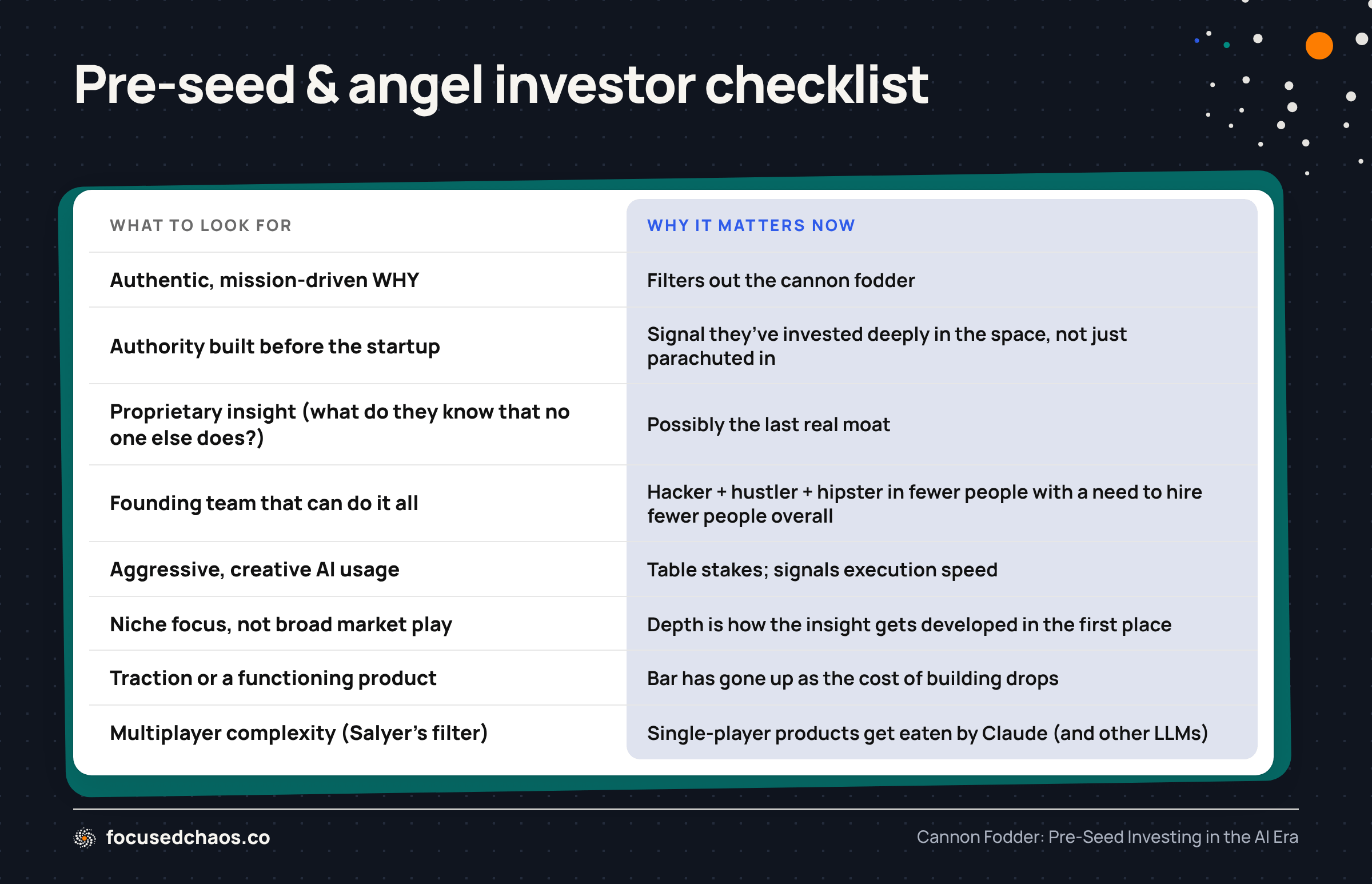
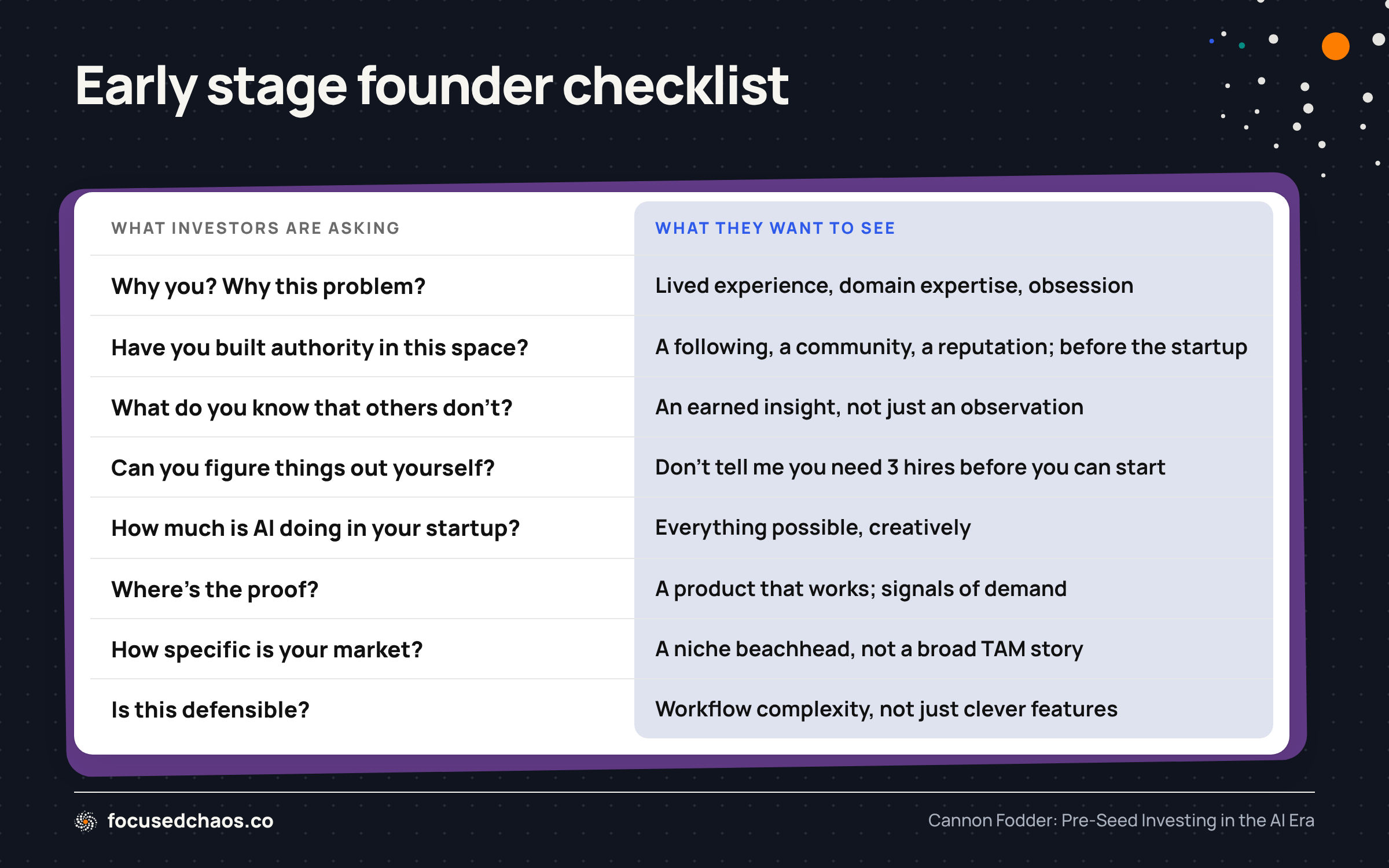
Quick Reference: What I’m Looking At
For founders and investors both, here’s how I’d summarize the framework I’m working from.
If you’re a pre-seed/angel investor:
If you’re a founder pitching at pre-seed:
The medieval siege analogy feels right to me because it captures the brutality in an honest way. Most things don’t make it. The casualties are real, even if the walls are metaphorical.
But the founders who have something real, who are genuinely on a mission, who understand their problem better than anyone can still break through.
The job, as a pre-seed or angel investor, is identifying them early and having the courage to make a bet.
100% agreed with the volume of new startups, and how many of them are going to fail.
I think there’s another question that’s missing, though. These days I’m asking founders “What was previously too expensive to scale, but is now doable with AI, for your customers?”
If they don’t have an answer, it means they either don’t know enough about their customers, or the solution may not be impactful enough to stand out in an increasingly noisy space.




100% agreed with the volume of new startups, and how many of them are going to fail.
I think there’s another question that’s missing, though. These days I’m asking founders “What was previously too expensive to scale, but is now doable with AI, for your customers?”
If they don’t have an answer, it means they either don’t know enough about their customers, or the solution may not be impactful enough to stand out in an increasingly noisy space.