

First, a Quick History Lesson
You’ve probably heard the term, “a T-shaped person.” It’s been floating around business and tech for 40+ years, and there’s a reason it stuck.
The concept traces back to the 1980s, when McKinsey & Company started using it internally to describe the ideal consultant profile. It made its way into mainstream business conversation when David Guest coined the term publicly in 1991. By 2001, Harvard Business Review had put a formal frame around it in an influential article about T-shaped managers and knowledge sharing. Then Tim Brown, CEO of IDEO, brought it to an even wider audience in a 2010 interview that became the most-cited articulation of the model.
The model spread fast. It got baked into agile methodology, talent acquisition, career development frameworks, and performance management systems.
McKinsey still uses it. A 2023 CompTIA study of HR and L&D professionals across the US and UK found companies still actively use the T-shaped model to guide talent management and training. Forty-plus years after it was coined, it remains the dominant mental model for what a great hire looks like.
The visual is simple, which is part of why it works:
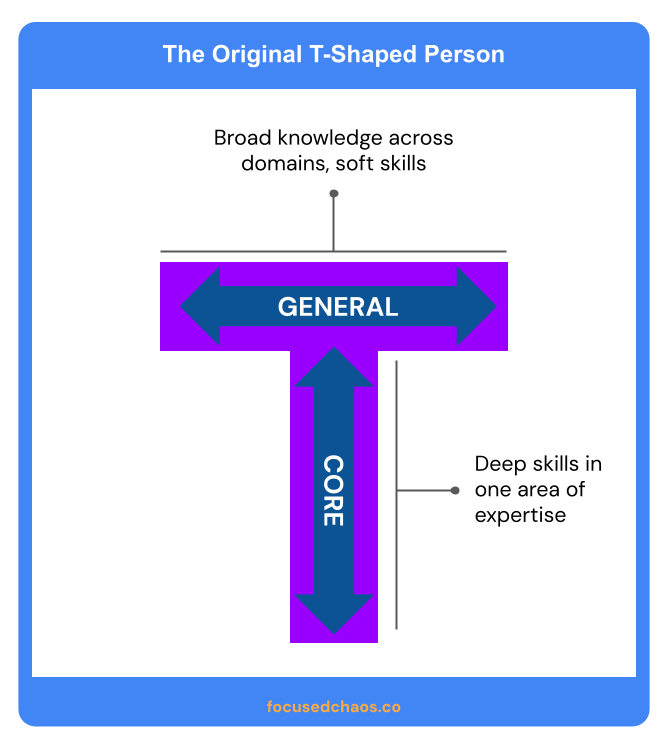
The vertical bar of the T = deep expertise in one domain. Your specialty. The thing people hire you for.
The horizontal bar = enough breadth to collaborate across disciplines. The ability to sit in a room with people from other functions and actually contribute to the conversation.
Research backed it up. Studies on agile teams consistently showed T-shaped members outperformed specialist-only groups on complex, ambiguous problems.
The concept got refined over time: Pi-shaped (two verticals), comb-shaped (many verticals), and more. Consultants, futurists, and HR practitioners kept iterating on the model.
But the core idea held for decades: be great at one thing, and be collaborative enough to work well with people who are great at other things.
That model is no longer enough.
What the T Got Right (And What AI Just Unlocked)
The original definition was more nuanced than most people remember.
Tim Brown, who popularized the model at IDEO, described the horizontal bar this way:
It’s the disposition for collaboration across disciplines, built from two things. First, empathy. The ability to stand in someone else’s shoes and understand a problem from their perspective. Second, enthusiasm for other disciplines, “to the point that they may actually start to practice them.”
That second part is the key phrase. And it’s the one AI just supercharged.
In the pre-AI world, enthusiasm for other disciplines had a ceiling. You could be genuinely curious about how engineers think, or how data analysts work, or how a marketer approaches positioning. You could follow that curiosity into books, courses, or conversations. But converting that curiosity into actual capability took years. Apprenticeship. Formal training. Time you often didn’t have.
So for most people, in most roles, the horizontal bar stayed at “collaborative and empathetic.” Genuinely valuable. But not execution-level.
AI removes that ceiling.
If you have the enthusiasm and the natural inclination to figure things out on your own, you can now actually do it. Not perfectly. Not at the level of a specialist with a decade of practice. But well enough to build something real, do or ship something useful, and keep learning from doing.
The curiosity was always the unlock. AI just made it exponentially more powerful.
What I’m Seeing From My Own Work
I’ve been building a lot lately.
An LLM/SEO Optimizer (if you’re interested, let me know!)
An innovation toolkit using Highline Beta’s best practices.
An applicant tracking system for Highline Beta and a few of our portfolio companies.
A web app for evaluating corporate venture studio readiness.
A ton of different automations for interlinking blog posts, adding LLM-specialized content to my web site, naming screenshots, removing backgrounds on images, and more.
These are all things I would have never touched even a year ago, because (a) I didn’t think they were my job; and (b) I didn’t have the capabilities.
I’m a product person. Not a developer. But the line is getting blurry in ways I didn’t expect.
Every week I’m posting on LinkedIn about new things I’m building or figuring out with AI. It’s not a flex. It’s just freaking cool what’s possible. Meanwhile, the tools keep improving, the things you can do keep expanding, and the skills I’m acquiring — even imperfectly — are changing how I think about my own work.
That’s when Tim Brown’s original framing really clicked for me.
I always had the enthusiasm for adjacent disciplines. I was always curious about how developers think, what good system design looks like, what separates a working product from a fragile one. I’ve been building software for 30 years, so I have a solid base of knowledge and experience, but now it’s growing exponentially.
AI is unlocking things I never thought possible. I’m not just collaborating with developers anymore. I’m doing development. At a certain level, in a certain context. Not at the level of a senior engineer building sophisticated systems. But building real things that work and deliver real value.
The curiosity was always there. AI just let me follow it all the way through to execution.
What AI Is Actually Doing to the T-Shaped Model
For most people, in most roles, the horizontal bar was decoration.
Not useless decoration. But you weren’t expected to ship code, or build an analysis, or run an ad campaign. You were expected to understand it well enough to direct someone else to do it or provide other experts with the information they needed to do their jobs.
That’s changing across every function, and fast.
Marketers are doing data analysis. Designers are shipping code. Operations people are building automations that used to require an entire engineering sprint. Finance folks are generating their own reporting without waiting two weeks for a data team. Product managers are building the things they used to only spec out.
Beyond that, marketers are now building products. Product managers are doing growth (which, in my opinion, should have always been their job), developers are doing design and so on.
This isn’t theoretical. This is happening right now, at companies of all sizes, across industries.
The horizontal bar is no longer about perspective. It’s about capability. Real, functional capability. Not “I can have a conversation with the engineer about this.” It’s now, “I can build a version of this myself and iterate on it.”
That’s a different standard. And it’s coming whether or not people are ready for it.
Wealthsimple Jumped In With Both Feet
Recently, Wealthsimple launched an AI Builders program. Pay attention to how they describe what they’re looking for:
“We’re looking for people who look at a broken process and can’t help but imagine what it should be. Who move fast in ambiguity, own problems end-to-end, and think carefully about where AI should — and should not — take responsibility. Your story tells us where you’ve been. Your build tells us where you’re going.”
Dig in a bit more and you’ll find the key signal: they explicitly say that your CV isn’t everything. Degrees and experience aren’t the gating criteria. What you can build is.
This is a major Canadian fintech with hundreds of thousands of customers, not a scrappy four-person startup, saying: the old signals of competence don’t automatically apply anymore.
They’re not alone. They’re just one of the first bigger companies to say it out loud.
The T-shaped model was built on the assumption that your vertical is your primary value, and your horizontal is a nice bonus. What Wealthsimple and others are signalling is: we need the horizontal to be real. Not soft skills. Actual functional capability across multiple domains.
So What Does the New Shape Look Like?
I’ve thought a lot about this, and I don’t think a new letter captures it.
Pi-shaped. Comb-shaped. These add more verticals, which misses the point. The problem isn’t that people need two specialties instead of one.
The problem is that the horizontal bar has to become load-bearing. It has to represent actual capabilities, not just social ones.
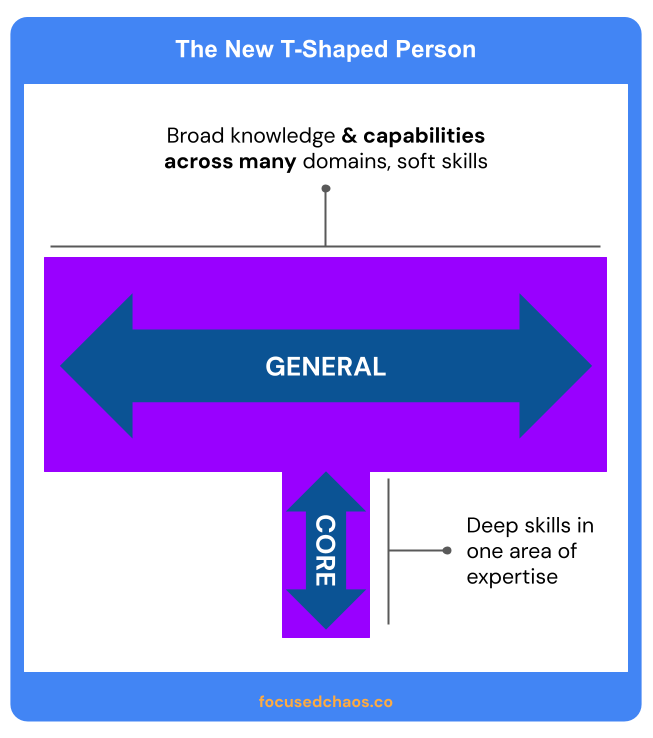
Maybe we should just turn the T upside down…
In the old model:
Horizontal = breadth of perspective, mostly soft skills
Vertical = where you actually deliver value
In the new model:
Horizontal = real functional capability across multiple domains, powered by and through AI
Vertical = still important, but increasingly table stakes rather than your primary differentiator
It kind of looks like Thor’s hammer. Not everyone is worthy…

Your specialty doesn’t disappear. But it’s no longer enough on its own, and the breadth piece is no longer optional.
AI Empowers Learning. It Doesn’t Replace It.
Before anyone gets the wrong idea: using AI doesn’t make you an expert in everything. Let’s not be silly.
I can build a working web app with Lovable or Claude Code, but I’m not a developer. I know enough to be useful. I know enough to ship something that works. I don’t know enough to architect systems at scale or debug deeply weird infrastructure problems. It’s easy to get caught in the hype and think that you can vibe code your way through anything. You can’t. You need enough foundational understanding to know when the AI is steering you wrong. And at some point, you need to bring in the experts.
AI compresses the time it takes to become functionally capable in something new. It doesn’t automatically install expertise.
What it does do is dramatically lower the activation energy.
That domain you always said was “not your area”? You can explore it now. And not just theoretically. You can build something in it. Fail at something in it. Learn from the failure. Iterate. That loop used to take years of apprenticeship or formal education. Now it can take weeks of deliberate experimentation.
That’s not magic. But it changes the math on what’s possible for any given person to develop.
The Skills That Actually Need to Be in the Horizontal Bar
If the horizontal bar is becoming load-bearing, what actually needs to go in it? I’m not talking about specific tools — those change too fast. I mean the underlying capabilities.
1. Comfort with ambiguity
People who need clear instructions before starting anything will struggle. AI-augmented work is exploratory by nature. You often don’t know exactly what you’re doing until you go through the process a couple times. If you freeze without a detailed spec, or you require a lot of handholding, that’s a problem.
2. Speed of experimentation
The willingness to try something, watch it fail, understand why, and try again. Not as a formal process. As a reflex. The people posting weekly about what they’re learning and building aren’t more talented than everyone else. They’re running more experiments and learning faster because of it.
Learn by doing. Please. I’m borderline begging you, because otherwise you’ll be obsolete.
3. Judgment about AI outputs
AI will confidently give you wrong answers (although it’s getting better). It will build things that work in demos and break in production. Knowing when to trust it and when to push back is a skill you develop through use, not through reading about it. You have to get your hands dirty to build that judgment. And as the Wealthsimple Builders program suggests, that judgment is going to become a critical skill for hiring.
4. Cross-domain curiosity
You can’t expand your horizontal bar if you’re only interested in your vertical. The people winning right now are genuinely curious about adjacent domains; not obsessively, but enough to explore and ask questions and try things.
Through building my LLM Optimizer I’ve done a deep(ish) dive into Schema frameworks, SEO, FAQ-style content, citations versus mentions, and more. I am not an expert at optimizing a website for LLMs, but I’m dangerous enough to do some cool things.
5. Self-directed learning
Universities aren’t teaching this. Most companies aren’t either. The people getting ahead are figuring it out themselves, sharing what they find, and iterating in public. Waiting for formal training is a losing strategy at the pace things are moving.
There are useful resources online to help, but relying on them isn’t worth it. Virtual classrooms are still classrooms. Pick up a few tools and get at it!
What This Means If You’re Paying Attention
If you’re a founder or exec: the T-shaped heuristic still works, but you need to re-weight it. The horizontal bar is becoming your primary filter, not a tiebreaker.
Can this person operate across domains? Are they learning fast? What have they actually built or figured out recently?
Those questions matter more than they used to.
The next time we’re hiring at Highline Beta, I’m all-in on the horizontal bar of the T. I don’t need deep experts in any particular field that are only interested in staying in their lane. I need people willing to say, “I’ve never done that before, but I can figure it out.” People that are insanely curious. People that just try stuff and figure it out. Without waiting to be told, without asking permission.
If you’re an individual: you need to deliberately expand your horizontal bar with real capabilities, not just soft skills. Pick one adjacent domain and get your hands dirty in it. Not a course. Not a certification. Build something. Ship something. Fail at something and figure out why.
If you’re in the middle of a career: the people who will be fine are the ones engaging now, with curiosity and a bias toward action. The people waiting for things to stabilize before jumping in are going to find the window closes faster than expected.
I’m not trying to panic anyone. But I’m living this awakening of “generalist superpowers” for myself and the rate of change is overwhelming.
The T Needs to Grow Up
The T-shaped model was a real insight. Depth plus collaborative breadth. It worked for decades.
But it was built for a world where the horizontal bar was a multiplier on your vertical. Today, the horizontal bar is becoming the foundation. “Collaborative” isn’t enough to describe what needs to be there.
The T needs to get wider. Much wider. And the width needs to mean something beyond being easy to work with.
The people who are building that broader foundation right now, even imperfectly, even messily, are the ones who will have the most options when this shakes out.
Start building. Even if you don’t know what you’re building. Especially then.