



From the beginning of this newsletter, I’ve gone through a fairly systematic approach to exploring opportunity areas, validating problems, building initial solutions and launching new startups.
If you’re interested, you can follow the journey through these posts:
How to Apply the Scientific Method to Startups Without Being a Zealot
Test First, Build Later: A Guide to Validating Your Ideas with Stimulus & Prototypes
I’d like to think I “practice what I preach.” Recently, I pursued an opportunity with my team at Highline Beta using many of the techniques I’ve written about. and I’ve shared the experience below. Consider this an “eating your own dog food” moment.
The entire process took a few months, but it can be done faster (we were doing a few things at once.) Having said that, there’s a benefit to “marinating in the problem space” and not rushing through the research in order to build a solution. Connecting the dots takes time.
A bit about Highline Beta
Highline Beta is a venture studio & VC firm. We build and fund startups from the earliest stages (at incorporation), often working with corporate partners.
Typically, we source opportunities from founders or corporate partners. Occasionally we pursue our own ideas or areas of interest, and we do so through a fairly rigorous, but rapid process to validate an opportunity and determine if there’s a new startup we could build through our venture studio.
1. Start with a Mega Trend
A lot of founders begin their startup journey with a mega trend.
A mega trend is a big, obvious thing happening in the world.
The “big” part is good, because it usually means there’ll be a lot of problems to solve, with a sizeable market.
The “obvious” part is not good, because it means everyone else sees the opportunity as well. If something is obvious, or the problems seem obvious, it means they’re likely “universal truths” and unsolvable without digging much further.
The aging population is a mega trend.

Here’s a quick overview from the World Health Organization:
People worldwide are living longer. Today most people can expect to live into their sixties and beyond. Every country in the world is experiencing growth in both the size and the proportion of older persons in the population.
By 2030, 1 in 6 people in the world will be aged 60 years or over. At this time the share of the population aged 60 years and over will increase from 1 billion in 2020 to 1.4 billion. By 2050, the world’s population of people aged 60 years and older will double (2.1 billion). The number of persons aged 80 years or older is expected to triple between 2020 and 2050 to reach 426 million.
While this shift in distribution of a country's population towards older ages – known as population ageing – started in high-income countries (for example in Japan 30% of the population is already over 60 years old), it is now low- and middle-income countries that are experiencing the greatest change. By 2050, two-thirds of the world’s population over 60 years will live in low- and middle-income countries.
Everyone gets old. Someone has to take care of the elderly and our current infrastructure is ill-equipped to do so. I’ve spoken with some people who see catastrophe around the corner. I’m with them. This is one of those massive problems that too many people ignore, despite seeing the mega trend emerging (some call it the “Silver Tsunami”), perhaps hoping it’ll just go away on its own. It won’t. And governments alone won’t solve it.
This parlays into another emerging trend, which is “aging in place” — the idea that it’s in everyone’s best interests if the elderly live in their homes as long as possible, reducing the burden on our over-taxed healthcare systems and providing people with a better quality of life. But aging in place is complicated (to say the least.) It poses a variety of giant problems including safety, loneliness, getting help, the family burden, financial challenges and more. Each of these problems is massive, which again is interesting if you’re looking to build solutions / startups, but also concerning because of the breadth of the challenges.
Mega Trends are Fine, But They’re Not Enough to Start a Company
You shouldn’t start a company from a mega trend alone. Mega trends are obvious (everyone sees them) and as a result you have no competitive or unfair advantage if you start in the same place as everyone else.
You should only start a company on an uneven playing field, where you have a legitimate advantage over the competition.
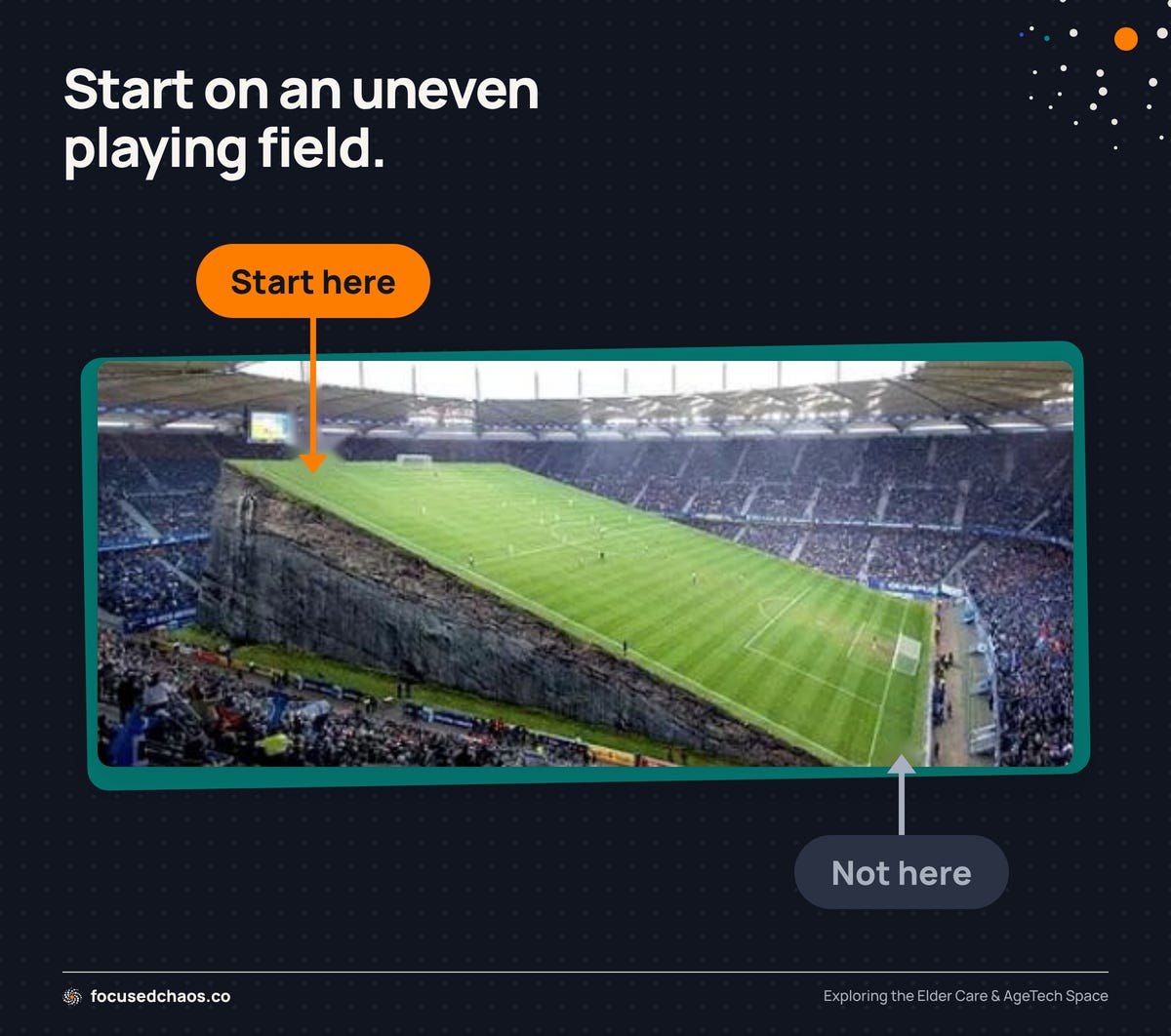
If your understanding of a problem or opportunity is entirely based on a mega trend, you only have a superficial understanding of what’s going on, which is going to lead to building a superficial, mediocre solution.
You need to dig a lot deeper to uncover pain points that matter, to a specific user group, that you could solve with some advantage over everyone else.
How I Explore Trends
Whenever I want to learn about a trend, I start with secondary research. The goal is to read up on a trend or topic and start to understand the key, big (but obvious) problems, emerging patterns, etc. Most of the time is spent searching, using Google or other tools like Perplexity. I’m looking for research reports, news articles, etc. that help me quickly get a handle on the space. Reddit and Facebook Groups are helpful, because people share a lot about what they’re dealing with. In the elder care space, many of the stories are heart wrenching. Blogs, newsletters or popular sites/forums/etc. are also full of valuable information.
I also look at what’s happening in the startup ecosystem. What sorts of startups are being created? What are VCs funding? Have any startups in the space managed to scale? If so, how?
The elder care / age tech space has a lot of startups, but not as many as you might think. My assumption is that the problems faced by the elderly aren’t as interesting to young founders, who would rather chase opportunities they’re familiar with. There are some big companies, but fewer than I expected. You can take this as a good sign (“Woohoo! There isn’t a lot of competition!”) or as a bad sign (“Where’s the startup graveyard? Why aren’t more founders building in this space?”) I suspect it’s a bit of both.
Sidebar: Create a startup/competitor tracker
It’s best to stay organized, and you’ll find more and more startups and competitors throughout the research process. Create a basic tracker that you can use.
Here’s an example spreadsheet we used for tracking elder care startups.
You can download and use it for free.
You want to look at the problem space from every stakeholders’ perspective. In the case of elder care, you see a large number of stakeholders (which smells like opportunity, but also speaks to the complexity of the space), including:
The elderly
Their families
Local, state/provincial and federal governments
Doctors and healthcare workers
Elder care facilities
Home healthcare providers
Insurance providers
Etc.
The elder care space is a giant spider web of crazy. (BTW, many markets are, and this is where a lot of founders get caught.)
With a bit more awareness and knowledge of elder care / age tech, I move to the next phase of the process: narrowing my focus.
Narrowing My Focus
From all the information I gather about a trend (or trends) I synthesize the data and decide where to focus. You can’t boil the ocean, and if you stay too high up in a mega trend for too long you’ll end up wandering around, getting lost in the noise.
In this case, I decided to focus on non-professional family caregivers—those who are taking care of an elderly family member (often their mom or dad.)
I felt like this market was underserved, and not only are they dealing with elderly parents, they often have young children as well. They’re known as the “sandwich generation.”
I also decided to avoid getting into the healthcare system in any depth, because of its complexity. I didn’t want to get into B2B software or solutions for hospitals, clinics, etc. And I wanted to avoid as much as I could with respect to regulatory issues.
With a narrower focus, and a rough sense of the problems faced by non-professional family caregivers, I dug in.
2. Talk to Subject Matter Experts & Various Stakeholders
My next step is almost always to speak with subject matter experts and various stakeholders.
The goal is to get a more fulsome picture of the challenges/problems, test some early hypotheses and learn as quickly as possible.
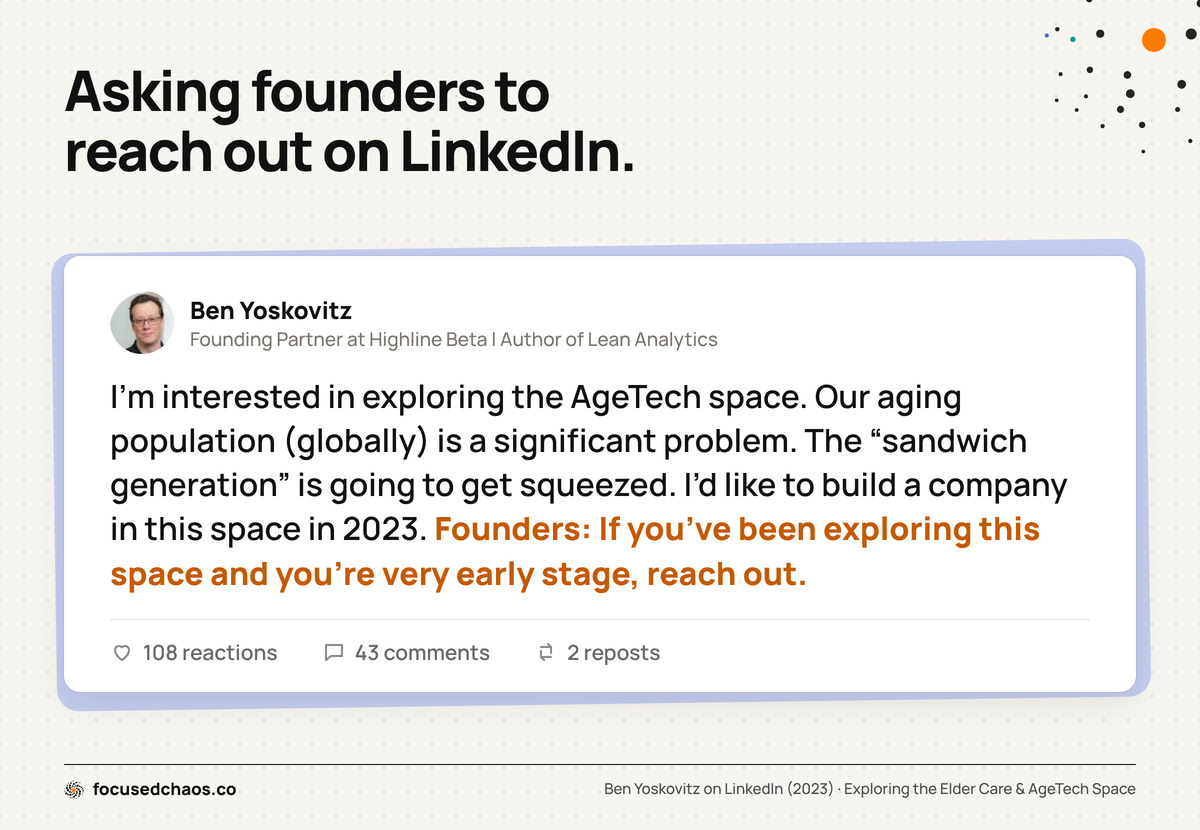
I put out requests on LinkedIn and Twitter looking to speak with industry experts in the elder care space. I told them I was exploring the idea of starting a company in the space, but was coming into it very open-minded to learn. I got lots of responses. Here’s one example soliciting early stage founders:
Sidebar: How to find people to speak with
You may not always have the network necessary to find people to speak with. In that case you’ll have to do more outbound. Most subject matter experts are on LinkedIn. Do research to identify 20-30 top targets, and then reach out cold. You may be surprised at the response rate if you position your objective as learning (people love to talk about themselves and their expertise!)
You may also find people on Twitter, Reddit, Facebook or other social networks.
You can find people’s blogs, newsletters, etc. and reach out there as well.
This can be a lot of grunt work. But that’s fine. It’s part of the process. If you can’t proactively reach out to 20-30 people for help, I doubt you’ll have what it takes to build a startup.
This is not the stage where you’re testing or selling a solution.
The goal is to fill in your knowledge gaps, get a feel for where the real roadblocks lie, and put yourself in a position to speak with potential users/customers intelligently.
I ended up speaking with at least 10 people, including several founders, investors and industry experts.
A few founders had built startups in the elder care space and failed. This is an excellent source of lessons learned.
Several founders were in the midst of building or scaling startups in the space. Again, a fountain of knowledge.
Investors are always interesting because they see a lot. I was able to get a sense of what’s happening in the pre-seed/seed and Series A stages.
Industry experts are often very good at shedding light on the pitfalls you’ll face and the market complexities. Try and tease out where they see unresolved issues (which might be the wedge in for your startup.)
At some point in this process you start hearing the same thing over and over. That’s a good sign that you’ve learned what you can and it’s time to stop. It doesn’t make you an expert, but you should move to the next step.
Generally, 5-10 (up to 15-20) subject matter expert interviews should suffice to move on (or not.) You should talk to more subject matter experts later on, but at this point you’re trying to paint a picture of the market, not dig into a very specific problem or solution.
3. Interview Potential Users/Customers
The next step is to interview potential users/customers. I was still committed to non-professional family caregivers, and once again I went out to LinkedIn and Twitter to see if anyone would speak with me.
When you’re tapping into an incredibly painful problem (i.e. taking care of your elderly loved ones) you get lots of responses. That’s a good sign. I had 40+ people reach out very quickly willing to share their stories.
A key reminder: You’re not selling a solution. You’re trying to validate the problem and understand these people’s experiences.
Working with the Highline Beta venture studio team, we began interviewing these users, getting their stories, looking for patterns and trying to narrow in on a specific problem we thought was solvable and could be the beginning of a startup.
Sidebar: How to successfully interview users
Interviewing people properly takes practice. It’s so easy to try and sell, or convince someone of something. You often end up asking leading questions, trying to solicit the answers you want to hear.
I always go back to a few fundamental resources on interviewing users properly:
We ended up doing 25+ interviews. Normally we target ~10, but we had so much interest in the topic that we felt it was worthwhile. But the other reality was that we weren’t hearing any one issue stand out amongst all the others. Whenever you’re doing user interviews you’re hoping one pain point or problem screams out at you. We were getting a lot of noise. Everyone agreed that taking care of an elderly loved one is difficult and stressful, but after that it was a bit all over the place. Nevertheless, we moved to the next step. Honestly, this had more to do with my bullheadedness to find a problem worth solving in this space than the data we were collecting. You’ll rarely have conclusive evidence of the perfect pain point to solve; the pieces of the puzzle don’t fall that easily into place. So you’ll rely on your own conviction and determination as well, but within reason.
4. Synthesize Learnings & Prioritize Problems

We were doing a lot of interviews and learning, but we struggled to pinpoint any specific pain points that stood out.
More precisely, we didn’t hear any specific pain points we thought we could solve.
Or any pain points where we thought we’d have a right to win, and could start a company on an uneven playing field.
While synthesizing learnings and prioritizing problems we continued to speak with subject matter experts and potential partners. I’d say we were having 50-50 success in terms of people being interested in the direction we were going. It’s OK if a lot of people are disinterested (it can even be a good thing, because it narrows your user/customer focus), but you always need some that are really, really, really interested. If the positive responses are lukewarm, it’s a bad sign. We still had a few very positive responses as we shared our learnings with people, which convinced us (along with my determination to figure this space out!) to keep going.
We ended up with 4 or 5 problems that we thought were interesting enough to pursue. But we felt that each one was a bit small—i.e. solving it on its own wasn’t enough. Many markets, including the elder care space, are rife with point solutions. Some times this is fine and works well as a wedge, but our sense was that a point solution may not suffice. We were already seeing user fatigue in terms of the choices they had to make, and how overwhelmed they felt dealing with their loved ones.
5. Prototype Concepts
In some cases when you have a few problems that you believe are equally valid, you pursue each one independently. We decided to take a different approach and “aggregate” a few things together. This is an equally valid approach to ideation and concept testing, but it also runs the risk of muddying the waters even further. When you present a solution that does 5 things it’s tough to know which of those things people really care about.
During our research into elder care we kept coming back to the concept of a care plan. Care plans are typically created inside of elder care facilities, where nurses, doctors and other healthcare professionals put together a comprehensive plan for providing a patient with care. This includes medical information but also other components including activities they should be doing, social, family, etc. At-home healthcare providers may also use care plans to track what they should be doing for a patient.
Many of the non-professional family caregivers we spoke with didn’t have a handle on the full care that their loved ones needed. They didn’t feel in control of the situation. We were excited about the idea of putting more control into the hands of family caregivers so they could better manage care.
We built several landing pages leveraging the value proposition of “being in control.”
We tested a couple other value propositions as well, using the care plan as the concept/solution. The idea was to provide family caregivers with a way of building and managing a care plan easily.
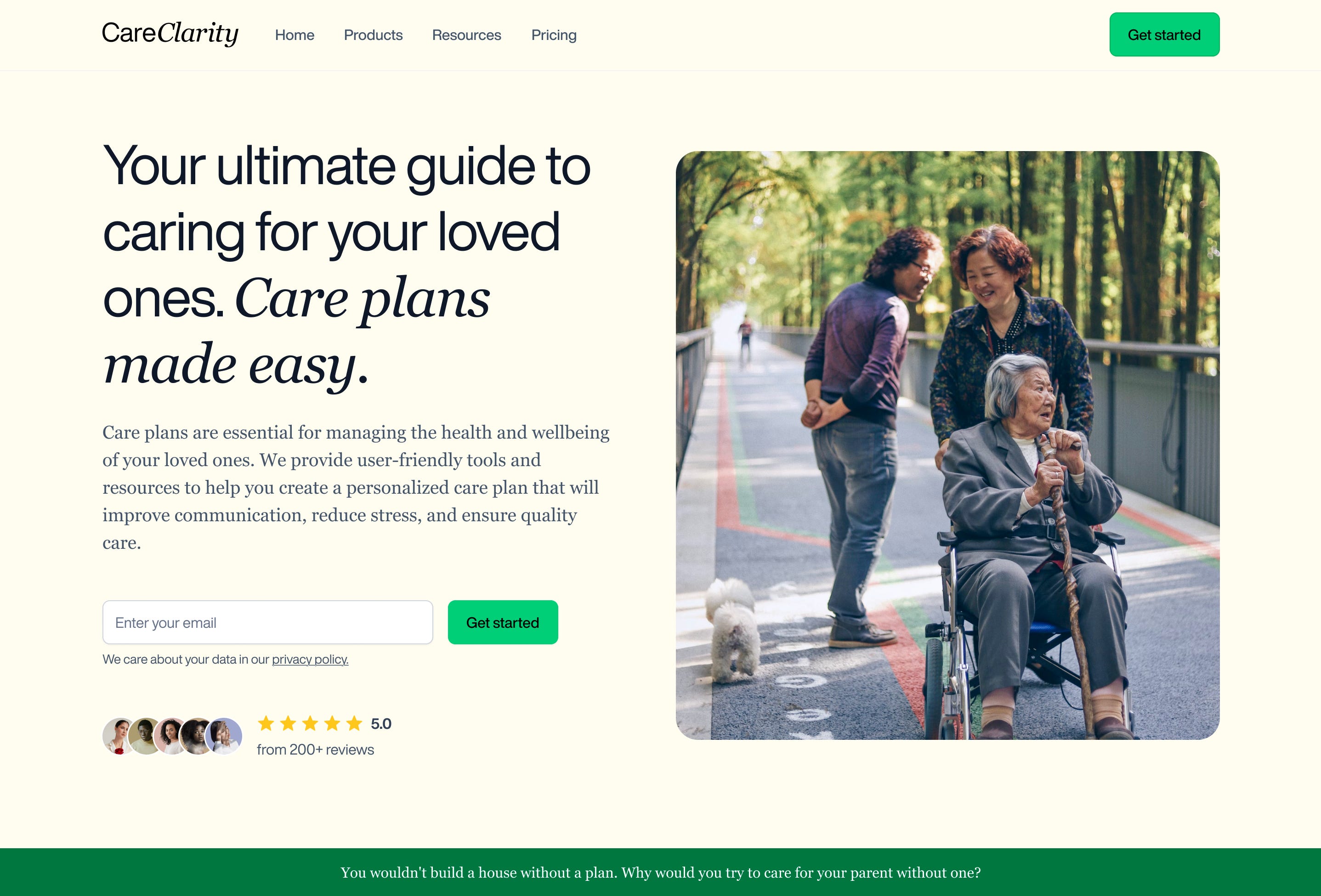
Using Facebook & Google ads we drove traffic to these landing pages to measure engagement (through clickthrough rate and signups.) We had a short survey available to people who gave us their email address, and we managed to interview a few users as well. We also went back to a number of people we had interviewed and showed them the concept.

Sidebar: Experimenting with AI
While we were testing value propositions through landing pages, we also experimented with AI’s ability to build custom, personalized care plans. OpenAI and ChatGPT have led to a lot of rapid experimentation, which is great, and we didn’t want to get stuck in an endless loop of landing page validation if we could launch something quickly and see what happens.
Although we didn’t release the care plan building tool, building the prototype was still a valuable experience. It allowed us to work more closely with the typically available data (for providing care), learn how to leverage ChatGPT and experiment very quickly on a number of the problems we had somewhat validated through our user research.
It’s easy to get caught in endless user research. You’ll never have complete confidence in the user research without putting something into people’s hands. The explosion of AI tooling and the use of LLMs has created a lot of very interesting possibilities.
Our care plan experiments weren’t as conclusive as we’d like. There was some interest, but not enough to move forward.
We kept coming back to the challenge of all the “little” problems that add up when it comes to providing care for a loved one. It’s not one big thing, it’s a bunch of smaller issues that pile up. On top of that, we had a good appreciation through our research of the market complexity and all the stakeholders.
The instinct in these situations is often to build an “aggregator” of some kind. If there isn’t one wedge problem you can solve incredibly well (with minimal involvement from multiple stakeholders) that users will pay for, then maybe you have to connect more stuff and solve more problems at the same time.
So we built a new concept, CareClarity, and launched several iterations of a landing page.
The pitch, leaning into some of our AI experimentation, was a “co-pilot for elder care.” The “co-pilot for X” thing is getting overdone fast, but we found one in the parenting space that gave us confidence and felt quite similar. (Note: Sometimes finding solutions in adjacent markets is a great way to figure out what to build and how to present it. Don’t look exclusively at direct or even indirect competition.)

The idea behind CareClarity is an AI assistant that can help manage care and solve many of the problems that family caregivers face, including: transportation, tracking medication use, appointment management, food ordering, coordinating care, etc. We also learned through our research that most family caregivers feel very alone and confused about what to do, so CareClarity said it would help with that as well (providing AI responses to questions, but potentially also leading to community/social components.)
We again used ads to drive traffic to the landing pages. We had a survey after sign-up to get more context around which problem(s) people were most interested in having solved.
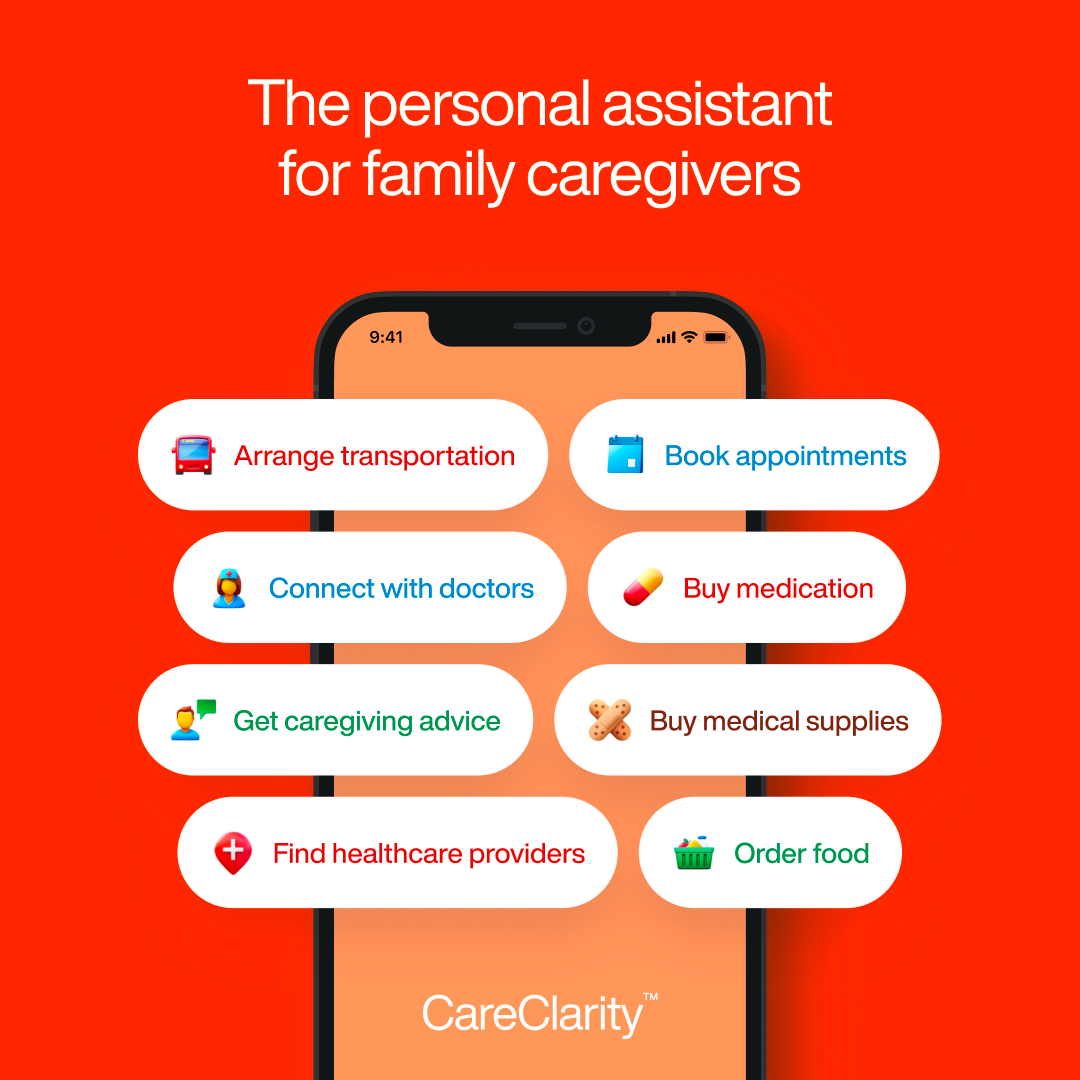
The results for CareClarity were stronger than those of our previous concepts, but still not fantastic. The survey respondents were split almost equally across a few of the problems, which again demonstrated the incredible complexity of the elder care space.
We went back to many of the interviewees from before and showed them the concept. Feedback was positive, but not overwhelmingly so.
6. We Parked the Idea…for Now
At this point, we still didn’t have enough confidence in what we were doing, so we parked the idea.
Everything you work on has an opportunity cost. If you’re not careful, you can spend a lot of time chasing something, running around in circles and wasting time.
We’d learned a lot and gained some insights, but not enough to build a business around.
We know there are problems in the space and the mega trends are pointing in the wrong direction (i.e things are only going to get worse!) but it still wasn’t enough to make a real bet; we hadn’t found a true “aha!” that we felt was meaty enough.
We couldn’t find the uneven playing field that would give us a competitive advantage. It’s possible we could keep going, even launch something in the market and then iterate (probably many times) in the hopes of cracking things, but I wasn’t ready to make that call.
A few other things to consider when you’re exploring a new opportunity:
Point solutions are great, but only if they’re a true wedge into the market. If you believe you can build a point solution (solving one specific problem) and get an MVP to market quickly, and get traction, you have a chance. But if the point solution is simply a “nice to have” or doesn’t get you into the market with real traction, you’re stuck.
The counter to the point solution is solve “everything at once” which is even worse. You’re not going to be able to solve “all the things” easily or well, even with the emergence of AI. There is a place for aggregators (sometimes these emerge as marketplaces), but it’s not where I’d go initially if I could avoid it.
The market remains messy and confusing. There are so many stakeholders, along with an incredible amount of emotion and stress. We managed to shine some light into a few corners of the market, but the picture remains fuzzy. If you find yourself in that position don’t assume you can bludgeon your way in and win.
Having said all of that, here are two other things that I think are always important:
Don’t hide your ideas. We were never shy about sharing our ideas/concepts/solutions with others. We welcomed feedback. We felt no risk that someone would steal our idea and run with it. Having concepts/solutions to show people (including a pitch deck we put together to show other investors and potential corporate partners) can really accelerate learning, and the potential for partnerships, pivots, etc.
Be open-minded. While you should stay focused on what you care about, you also have to be extremely open-minded. If all the evidence tells you go left, but you’re stuck going right, you’ll lose. Being open-minded to uncovering new problems, insights, solutions, markets, etc. is what allows you to learn the most (and quickly) and iterate. Don’t close yourself off to opportunities.
I remain committed to building solutions in the elder care space. Although we didn’t get enough conviction through this work, we learned a lot and we are closer. We’ll continue to explore the space, engage with founders and others, and I’m fairly confident we’ll build a company in elder care / age tech at some point in the future.
Very intriguing, and very interesting. The need is definitely on point. My 2 cents - AI assistants on helping navigate mundane or routine stuff for the elderly (normal times or at medical care) is great, however, what we also see is that parents have a basic digital support system through their children or young next to kin (ofcourse there would be an unfortunate sample size too). Instead, where I feel the digital support is completely clueless or lacking control is where the elderly is out of sight, for example, not book appointment but go, travel, sit, meet, return back home (physical invisible piece outside digital), not book lab tests but field technician coordination with home phone or address, attend, give samples, technician leaving, elderly post sample care (physical invisible piece outside digital), etc. This is where probably a physical + digital concierge service would complete the loop. Digital enablement in agetech is great, but real MVP lies in enabling their physical movements. Having said that - great and detailed thought out and pen down. Would love to learn/know more to follow this space.
Thanks for sharing your insights Ben! I’m also really interested in the AgeTech space and have been looking for ways to get involved and build.
I’m not sure if you’ve come across this website, but it maps out AgeTech companies in 2025: https://thegerontechnologist.com/
AGE-WELL also works with startups and could be a great resource—I used to volunteer there and really love the work they’re doing to advance research in this space.
From my research, I haven’t seen much Canadian VC investment in AgeTech companies, or perhaps there just aren’t many yet. However, I believe this will be a growing industry with an aging population. I’d be interested to hear if this aligns with what you’re seeing at Highline Beta.