


Brent Harrison has built products and growth engines across venture-backed startups and global companies including Apple, Expedia, GoDaddy, and Netscape. He now spends most of his time advising venture-backed founders and CEOs when growth becomes less predictable. Brent’s first career wasn’t in technology; he was a Smokejumper, parachuting into wildfires in Canada’s Yukon Territory.
For more on Brent, check out his Substack: Growth Recalibrated, a weekly diagnostic for founders, CEOs and product leaders navigating growth inflection points. You can also find him on LinkedIn.

I recently met with a B2B software founder about the challenges he’s facing. The company hit $12M ARR and he believed they had achieved initial Product-Market Fit (PMF) 18 months prior (e.g. net revenue growth of 120%+, shortening sales cycle, rapid growth among “look-a-like” ideal/target customers).
But over the past two quarters, something shifted. The roadmap debates that used to resolve in a single meeting now drag across three. His sales team is requesting features that serve customer profiles he didn’t used to close. When a new hire asks him to describe the ideal customer, he finds himself hedging in ways he didn’t before.
I asked him what he thought was happening, his answer was immediate: “It’s hard to tell if this is normal friction or something more structural.”
That ambiguity is usually the first signal. He doesn’t have an execution problem. His product-market fit is eroding.
Product-Value Fit and Product-Market Fit Aren’t the Same
Ben has written extensively on Focused Chaos about what PMF actually requires: a product that creates genuine value, customers who pay in some meaningful form, and a repeatable way to acquire more of those customers at scale. That third element is the one most companies underweight. Product-Value fit (the sense that existing customers love what you’ve built) can look a lot like PMF. It isn’t the same thing.
Consider what the full picture looks like when everything is working. This company (offering a B2B infrastructure solution for location services for mobile applications) hit all the right signals: net revenue retention above 120%, sales cycles that collapsed because buyers already had budget and urgency, API usage climbing as existing customers scaled their own products. By any reasonable measure, the system was working.
Then net new customer acquisition stalled. Not because the product declined. Because the company had worked through the initial Ideal Customer Profile (ICP) of fast-growing apps that already needed location services. When that cohort was exhausted, sales cycles expanded again. It wasn’t the team’s fault; they now had to educate cold prospects rather than convert warm ones.
The underlying market also shifted. As Android and iOS embedded basic location capabilities natively, the addressable market for a premium/custom API quietly narrowed. Product-Value fit was intact. The distribution engine needed to reach and acquire new customers at scale had never fully developed.
This is only one pattern. Market exhaustion and platform shifts are real causes of growth stalls, but so are ICP drift, channel saturation, pricing compression, and competitive entry. What the diagnostics below are designed to catch isn’t any specific cause…it’s the moment the system starts losing coherence.
Where PMF Erosion Shows Up First
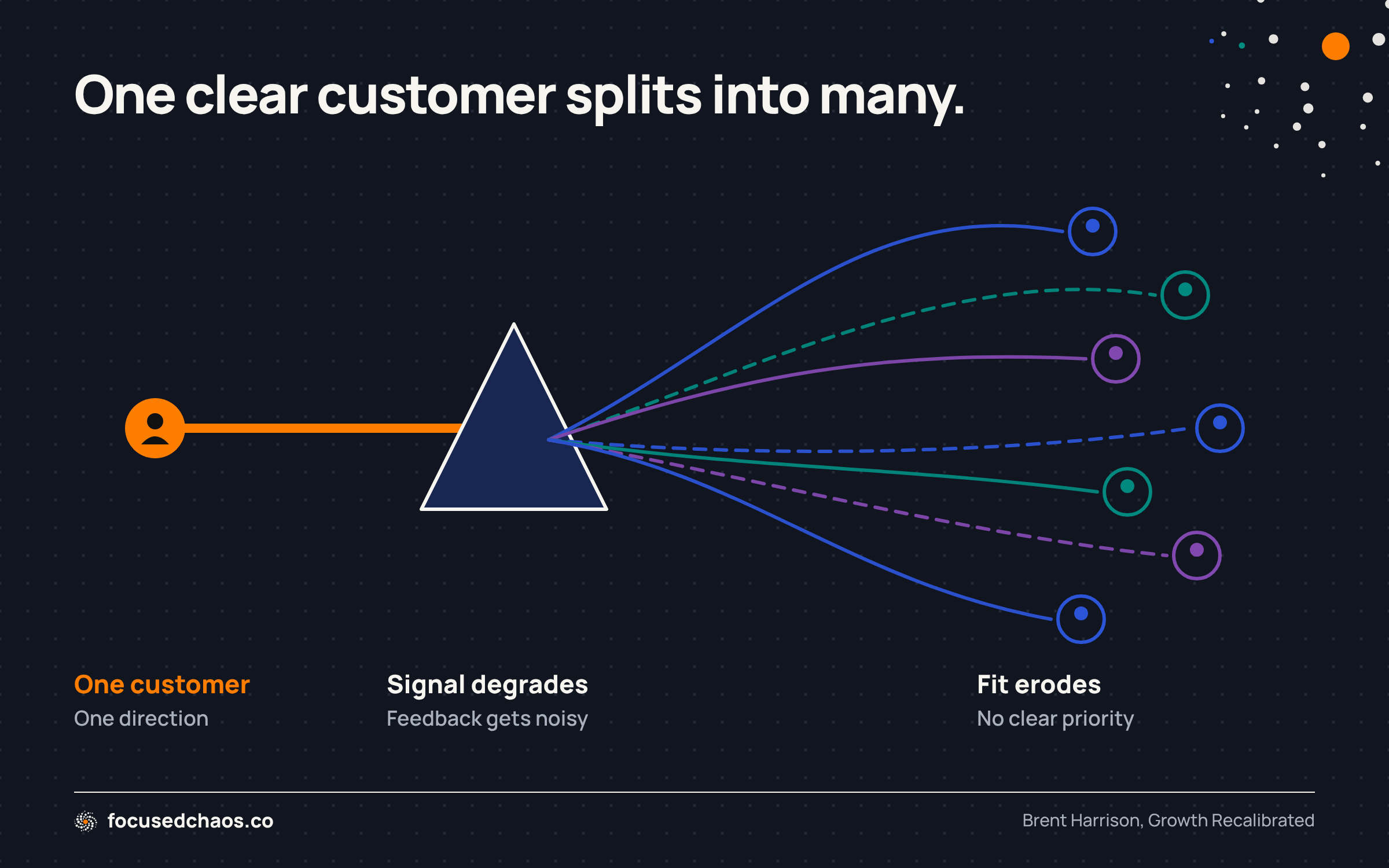
PMF erosion doesn’t announce itself in revenue or retention. By the time it appears there, it’s been compounding for quarters. The earlier signals show up across three dimensions.
Ideal Customer Profile (ICP) drift. As I’ve written about, ICP expansion at this stage is rarely a strategic move. When the original segment starts producing less reliably, the instinct is to cast wider. Sales closes deals with profiles that are “close enough.” Marketing broadens the message to stay relevant. Each individual decision has logic behind it. Together, they represent the original fit quietly giving way to a more diffuse version of the customer the company was built for.
Product signal decay. This one is less discussed and harder to see. When a company has genuine PMF, the product team receives a coherent signal from customers: the same pain points, the same use cases, the same feature requests clustering around a clear job to be done (JTBD). As fit erodes and the customer base diversifies, that coherence breaks down. Feature requests start arriving from multiple directions at once because different customer types now need meaningfully different things. The roadmap debates that once had a clear anchor (e.g. what does our core customer need?) start generating multiple legitimate answers. The product is still shipping. What’s decaying is the clarity of what to build and why.
Messaging drift. The value proposition that used to close deals gets softer at the edges. Not because the team is less prepared, but because no single explanation covers the range of customers’ needs the company is now selling to. The pitch broadens to stay relevant. Specificity gives way to optionality. Deals still close, but the team finds itself making slightly different arguments to slightly different buyers, with slightly different framings of what the product does. Each version is defensible. None of them is as sharp as the original.
Why PMF Drift Looks Like an Execution Problem
These three signals compound quietly. By the time they show up visibly — longer sales cycles, softer conversion rates, board questions that are harder to answer with confidence — they read as execution problems. Leadership responds with execution solutions: more pipeline, tighter process, a new hire. Each response is reasonable. None of them addresses the underlying cause.
That’s what makes this stage expensive. As one marketplace founder put it to me directly: “If you’re only selling to promoters, your net promoter score is going to be really good.” The surface holds. The erosion happens underneath it. Companies operating in that ambiguity tend to address symptoms for several quarters before realizing and naming what’s actually happening.
The Diagnostic
Three questions cut through the noise faster than any metric.
1. Deal Assessment
Pull your last 20-25 closed deals. For each one, ask:
Who actually bought it?
What problem were they solving?
What triggered the decision to purchase?
Then run the same exercise on the cohort you closed 9-18 months ago. If the buyer profile, problem, and trigger have shifted meaningfully - not dramatically, but meaningfully - the center of gravity has moved.
2. Internal Consistency
Ask your product, sales, and marketing leads separately to describe your best-fit customer today. If you get three substantially different answers, fit has already fragmented across the organization’s mental model, not just the pipeline.
3. Primary Acquisition Channels
Are conversion rates holding or declining? Is the cost to reach a qualified prospect rising? If existing customers are healthy and expanding while new customer acquisition is getting harder, the issue may not be ICP drift at all. It may be that the pool of ready buyers has narrowed and the company hasn’t built the distribution engine to reach beyond it.
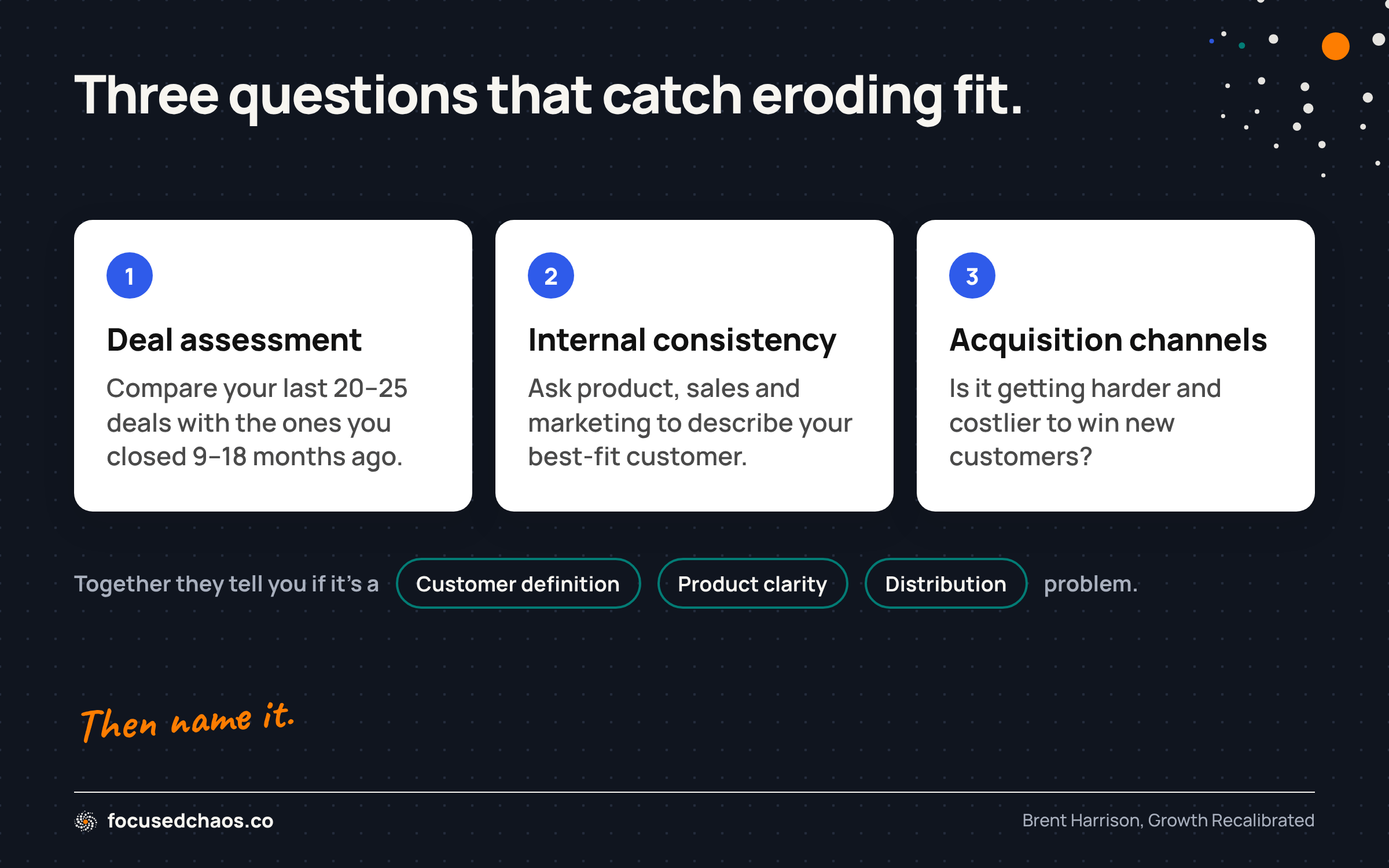
None of these is definitive alone.
Together, they tell you whether the original fit is intact, where the erosion is coming from, and whether you’re dealing with:
a customer-definition problem,
a product-clarity problem,
or a distribution problem.
That distinction determines what comes next.
What To Do When You Find Drift
The first and most important step is distinguishing between two very different situations, because they require different responses.
1. Accidental Drift
The ICP or product focus shifted without a deliberate decision to go there. If that’s what the diagnostic reveals, the path forward is to narrow back. Say no to edge cases. Recommit to the original customer profile. Tighten the product roadmap around the core JTBD.
This feels counterintuitive when growth is the goal, but it’s often what restores the coherence that makes growth repeatable. The companies that do this well treat narrowing as a strategic choice, not a retreat. They get more specific about who they serve, sharpen the value proposition around that customer, and let the clarity do the work that activity couldn’t.
2. Deliberate Recalibration
Where the original market is genuinely exhausted, has shifted structurally, or was never as large as it appeared. This is harder, and riskier. The companies that navigate it well make an explicit choice about the next customer: who they are, what job they’re hiring the product to do, and why this company is the right solution. The ones that struggle continue treating the new segment as a slightly adjusted version of the old one, which means the same erosion pattern repeats in a different direction.
In either case, the organizational move is the same: name it explicitly.
When the leadership team can’t agree on whether the drift is accidental or structural, the company will continue operating under different assumptions and every debate from roadmap to Go-To-Market (GTM) to hiring will be harder to resolve than it should be.
And what happened to the startup I referenced at the beginning of the post?
They chose the “deliberate recalibration” path. The core organization stayed focused on serving and expanding existing customers and contracts, while the original founding team was carved out to rapidly discover the next $50M product and market. Structurally, it was the right call. It still produced real tension between the two founders over authority, resourcing, and whose mandate now defined the company, but at least they made a decision and pushed towards it. Time will tell if it was the right one.
Thank you Brent for this great post and deep dive on PMF. People: please go check out Brent’s newsletter.

Great diagnostic. One additional dimension I’d consider is value realization. Who is realizing the strongest ROI, and for which use cases/JTBDs? That often provides the clearest signal of what your ideal customer actually looks like.
the internal consistency test is the one I'd run first, before touching CAC or conversion numbers. most orgs think they're aligned because everyone nods along in the same roadmap review... ask three leaders separately what the ideal customer looks like and you'll usually get three different answers ..