


Software companies used to charge for access. Seat-based pricing was the most common model. Companies paid whether they used the seats or not. Vendors charging per seat worried about creating value and reducing churn, but they also made a lot of money on unused seats and customers that forgot to cancel. They still make a lot of money with this model, despite the turmoil of AI.
AI changes the per seat subscription business model. One of the big reasons is that it now costs you money when a customer uses your AI product.
As a result, more AI companies charge for usage instead. ICONIQ, a growth investor that surveyed about 300 executives at software companies building AI products, found that the share using consumption-based pricing rose from 35% to 42% in six months (between Q4 2025 and Q2 2026). Kyle Poyar, who writes Growth Unhinged, found that 76% of AI-native companies use some form of variable or hybrid pricing, compared to 49% of SaaS companies.
Investors, who hated how hard usage revenue was to predict, now mostly prefer it, even though it’s still hard to predict. I’m seeing this with several of Highline Beta’s portfolio companies that are currently fundraising. A couple of years ago everything was about ARR (Annual Recurring Revenue). Now it’s all about usage-based revenue growth.
And I get it. Customers pay for what they use. Use goes up, revenue goes up. What’s not to love?
Let’s dig in…
Usage revenue looks recurring, but it isn’t until customers come back. Every unit you sell costs you something to deliver, and that cost shifts as the models change. Customers say they want to pay for what they use, right up until they see the bill.
The big question is this: will customers keep coming back for more, and do you make money on each “unit” as usage grows?
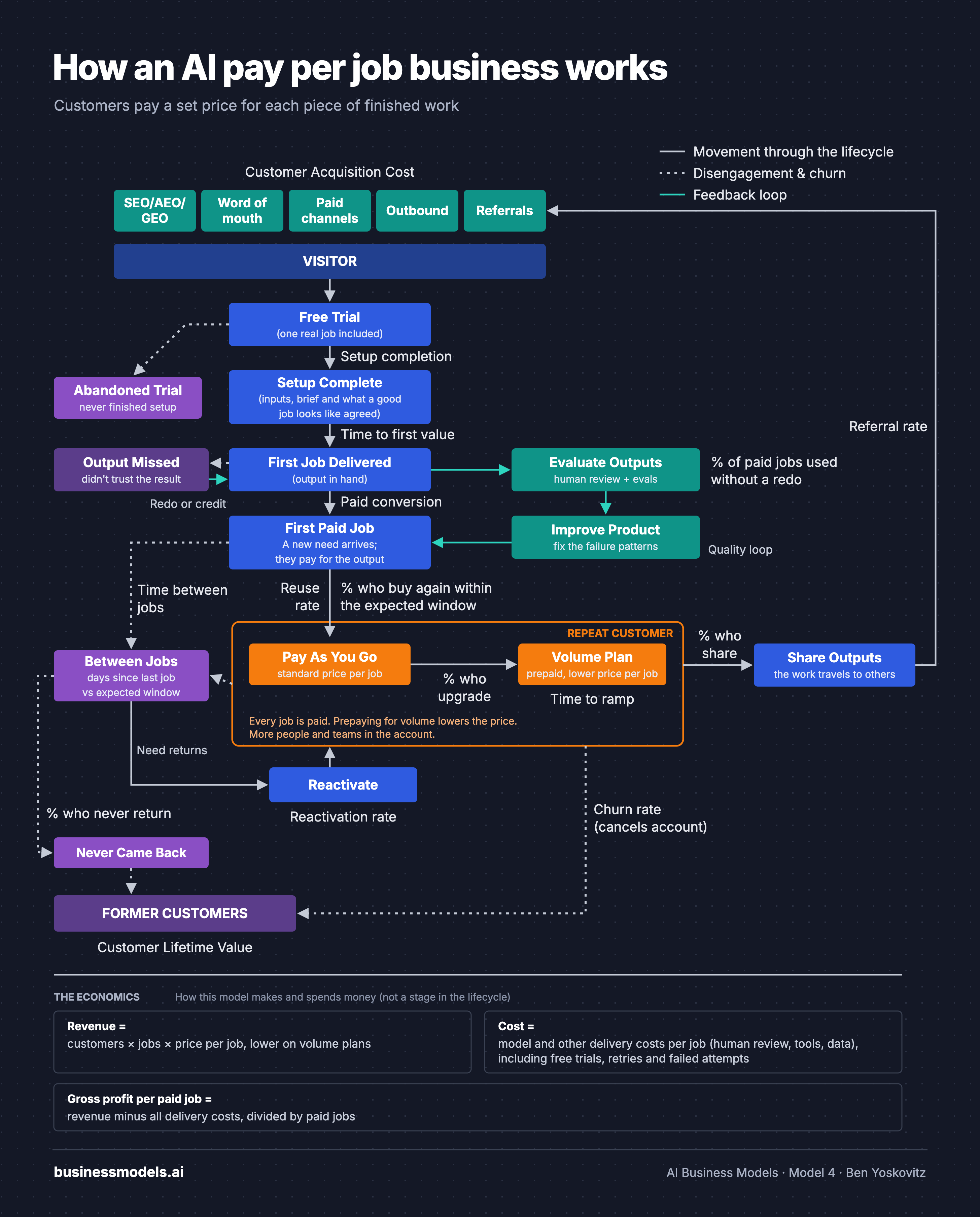
Usage-based pricing comes in a few flavors: paying per token, buying a monthly pool of credits, or paying per job. This post is specifically focused on pay-per-job, which I mapped in AI Business Models. It digs into the evidence, the economics and the metrics that matter.
What are you asking customers to pay for?
Bain & Company, the consulting firm, looked at the public pricing of roughly 200 B2B software companies in June 2026. Among those that meter AI usage, about 55% charge for output, 35% charge for effort and 10% charge for outcomes.
The simplest way to compare these models is based on two key questions:
Who pays when the work takes longer than expected?
Who pays when the result falls short?
Here’s how they compare:
Effort. The customer pays for tokens, compute or time. If it takes ten billable attempts to get a good result, they pay for ten attempts. You still have to manage your own cost per unit of effort to ensure there’s margin.
Output. The customer pays for a job, like a contract review or a grant application draft. At a fixed price per job, you absorb the cost of extra work. The customer can still end up paying for work they can’t or don’t use.
Outcome. The customer pays when the work meets an agreed standard of success, like a support issue being resolved. You cover the cost of attempts that don’t qualify for payment. Both sides have to agree on what counts as resolved.
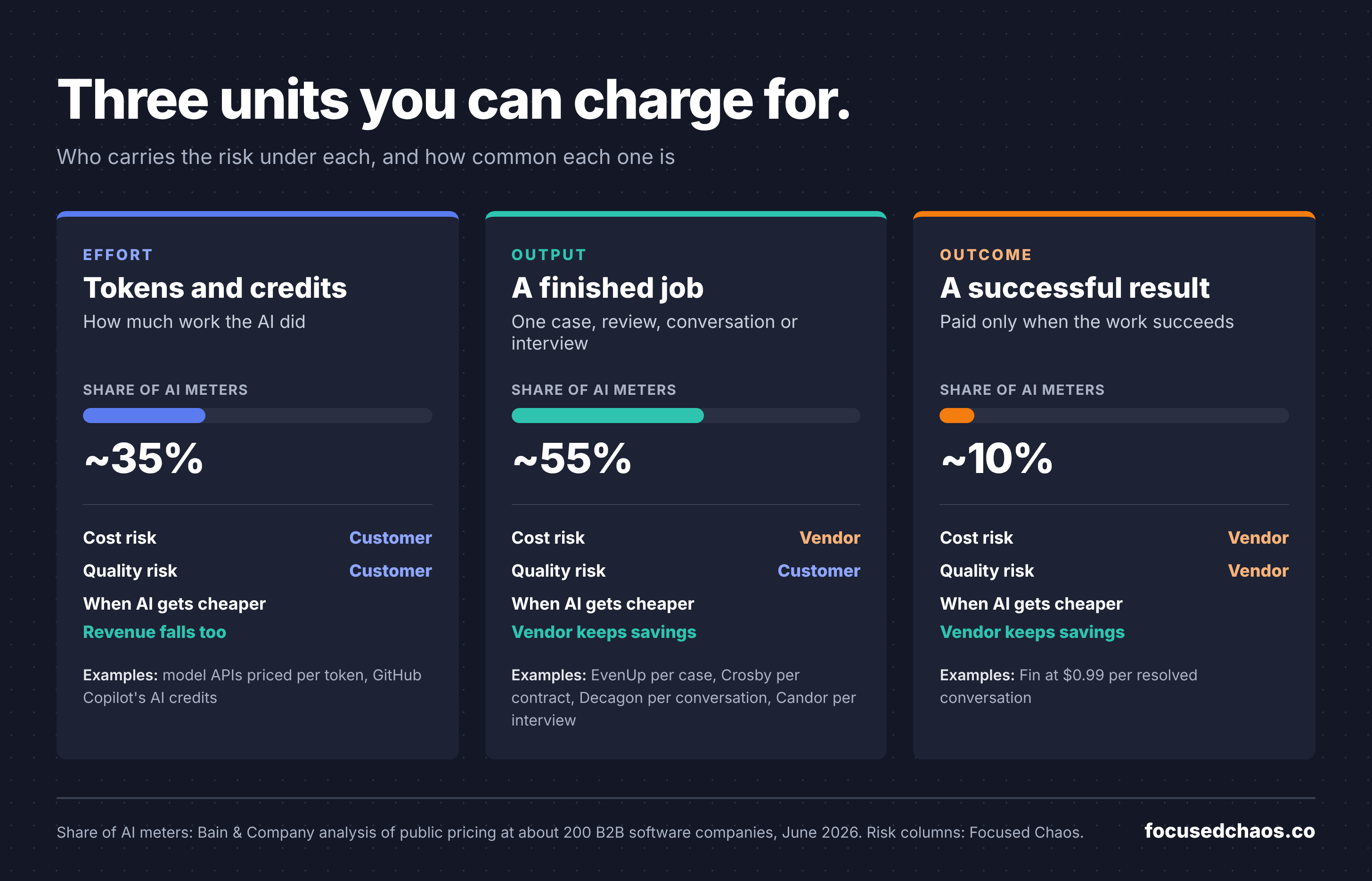
Credits can be used to bill for any of the three. The question is what uses up the credit. An interview? A minute of compute? A resolved ticket?
Outcome pricing gets the hype, but output pricing is what most companies do. Orb tracked 80 AI agent companies this year: 91% charge on usage, and fewer than 4% charge on outcomes. That share went down from last year. Kyle Poyar put it well: “Outcome-based pricing is a great message to the market. But it might be a better message than buying model.”
Fin (acquired by Salesforce) shows why. It charges only when a conversation is resolved, but it pays to run every conversation. Tommy Bettles, Fin’s VP of financial planning and analysis, said the product launched with negative margins. What improved things was the resolution rate, which climbed from the 30s to the high 60s. Every point of improvement turned a cost into revenue.
As I continue working on Candor, Highline Beta’s synthetic user research platform, I think about pricing a lot. We charge for usage, not outcomes, but I’ve thought about how outcome-based pricing might work. The challenge is defining a “successful synthetic user interview.” Would it be focused on whether the researcher learned something new? That the findings from the research were used to make a decision? Something else?
What counts as a job?
If you charge per job, the job is the product.
A customer should be able to look at the invoice and know exactly what they got for their money. As I wrote in AI Business Models, pay-per-job only works if you can define the job clearly, and your customers agree with your definition.
A good job unit has three things going for it:
Customers already count it. EvenUp, which prepares the documents personal injury lawyers send insurers to negotiate settlements, charges per case. Law firms already think about their business in cases. Decagon, an AI customer service company, says most of its customers choose to pay per conversation, a number every support team already tracks. Nobody has to translate the unit into something they understand.
Customers can use it as delivered. No back-and-forth, no rework. A grant application draft that needs a full rewrite isn’t a finished job. It’s half a job, and the customer knows it.
Customers can predict what it takes. A two-page application for a local community grant and a 40-page federal application aren’t the same job, even if both are “a grant application.” If the effort behind one job can be ten times the effort behind another, a single price won’t work. Price by size, or split the big job into smaller ones.
With Candor, I charge per interview, although I think most customers think in a different unit: studies. They run a study, and the study has interviews. The results of the interviews are where the value sits, but my costs are heavily in the interviews. And each study could have between 15-24 interviews, which significantly changes the cost. So I went with a “per interview” fee, but a simpler version would have been “per study.”
What’s a good job?
Defining the unit is half the work. The other half is agreeing on what a good one looks like. You can’t promise an outcome (the grant gets funded, the case settles), because too much is out of your control. But you can define a good job by what the customer can check when they get it.
Do these four things:
Ask customers what they’d accept from a person doing the same work: a junior grant writer, a paralegal, a research assistant. That’s the bar.
Write the bar down before the work starts, so “good” isn’t decided after the customer has seen the result.
Offer a redo or a credit when a job misses the bar, so the customer isn’t stuck paying for something they can’t use.
Count the jobs customers actually accept. That number tells you more than the number you sold.
For Candor, we’re still figuring this out. But the goal is to ensure that a customer learns at least a few new things from each study. If they do, we think the value is warranted. What’s learned doesn’t have to be some incredible revelation, but it needs to be enough that the customer wants to keep using Candor. Measuring learning is tough. Ultimately, I’d love to figure out what decisions or changes are made as a result of running a Candor study, and if there’s at least one decision that comes out of each study, I think that’s worth it.
One good month isn’t recurring revenue
Imagine you launch an AI tool that writes first drafts of grant applications. You charge $40 an application.
In your first month, 200 nonprofits try it. 150 pay for at least one application. Some pay for three or four. You make $10,000. Annualize it, and that’s $120,000 in ARR. Put it in the deck!
But dig deeper. What did you actually learn?
You learned that nonprofits will pay you to draft grant applications. You learned you could get the product in front of them. Both are hard. Take the win. 🥳
Now look at those customers. Did they submit the drafts? Did they rewrite them from scratch? Did a big funding deadline drive half the orders? And when those nonprofits apply for another grant, will they come back?
You earned $10,000. The $120,000 is a run rate based on one month. Whether the revenue repeats depends on what those customers do the next time they need a grant application.
This isn’t a made-up problem. Fortune’s Allie Garfinkle reported on founders counting pilots and other uncommitted revenue as ARR, and one VC told her that “so much of this is essentially vibe revenue.” Vibe revenue sounds cool, but it’s not a guarantee of success. It usually means people are experimenting, mucking around and testing out new tools, but aren’t necessarily going to stick around. TechCrunch’s Marina Temkin pointed out that annualizing a month of revenue “can be misleading” because so many AI companies charge based on usage.
With Candor, we don’t necessarily know at the outset how often a customer is doing research. Is it once a month? Three times a month? Quarterly? More? Less? Two customers that use Candor the first time look identical. Even if they both tell me, qualitatively, that they’re happy, I don’t know if they’ll use Candor enough to make it worthwhile. And if I don’t get qualitative feedback, I can’t tell if they’ve churned or are simply waiting for their next research project. This makes figuring out how things are going quite difficult.
Pay-per-job needs to validate two things
For an AI business that charges by the unit, start with two questions:
Will customers pay for the next job when they need it?
How much money do you keep when they do?
The first drives retention. The second drives margins. They can pull against each other. You can delight customers with the most expensive model, extra checks and generous limits, and watch your margins disappear. Or you can squeeze costs with cheaper models and fewer checks, and watch customers quietly stop coming back.
AI tool retention isn’t as strong as SaaS subscription retention. That should worry anyone that’s switching business models.
ChartMogul, a subscription analytics company, found that AI-native companies with at least $250,000 in ARR had a median gross revenue retention (GRR) of 40% in 2025. Products charging under $50 a month kept only 23%. As Kyle Poyar put it in ChartMogul’s report, “The downside of being easy to buy is being easy to cancel.”
Ben Murray, who writes The SaaS CFO newsletter, found similar churn issues for companies that only charge for usage. But, he also found that net revenue retention (NRR) was higher at 108% compared to 98% for seat-based pricing.
Essentially: If you sell an AI product through a usage-based model, expect to lose more customers, and to grow faster with the ones who stay.
The second question on margins is hard to answer too. ICONIQ found AI products averaged 45% gross margins. Averages hide big swings. Sacra, a research firm that tracks private tech companies, estimates that the gross margin of Replit, the AI coding platform, went from -14% in April 2025 to 23% by July 2025.
Applying Lean Analytics to pay-per-job
In Lean Analytics, Alistair Croll and I described five stages every business goes through: Empathy, Stickiness, Virality, Revenue and Scale. The stage you’re at tells you which metrics to focus on.
Pay-per-job makes the stages confusing, because somebody can pay day one. It’s easy to think you’re in the Revenue stage. But the Revenue stage is about optimizing the economic engine of the business, and you can’t do that until you know customers come back. It’s the same as AI-native services businesses, where you get paid right away, but that doesn’t mean you’re hitting a revenue stride immediately.
Here’s how I’d apply the stages for a pay-per-job business:
Empathy: Is there a job customers need done often enough, and will they accept the unit you want to charge for? Will they try a real job, not a demo?
Stickiness: Do customers pay for the next job when the need comes up again? Do they use the output, or redo it?
Virality: Does usage spread to other people and teams inside the account? Does shared work bring in new customers? Have you found the right channels to acquire “good” customers that will use your product at a high frequency?
Revenue: Do paid jobs earn enough to cover their own costs, plus the retries, failures and free trials you can’t charge for? Does usage per customer grow?
Scale: Can you grow without a few heavy customers, or one model provider’s price change, controlling your economics?
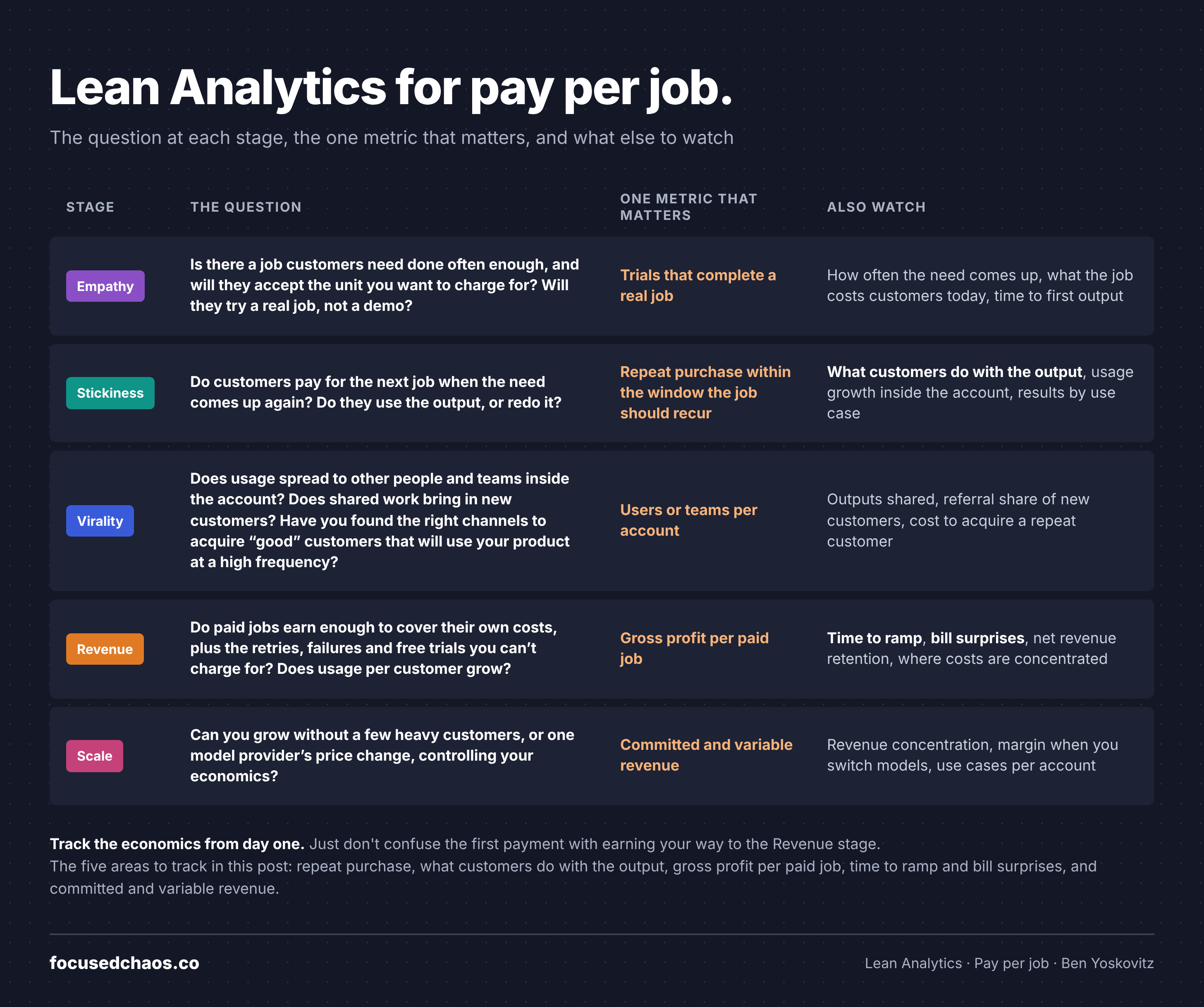
Most pay-per-job AI companies are in Stickiness, whether they know it or not.
In Lean Analytics, we wrote about ClearFit, a recruiting software company that dropped its monthly subscription because its customers hired sporadically. As its co-founder put it, “People don’t do subscriptions for haircuts, hamburgers and hiring.” (Admittedly, Lean Analytics was published in 2013, and since then I believe we’ve seen hair salons try subscriptions, and certainly recruiting companies have tried subscription models too. But the message is still important: you need the right business model for what your customers expect and how they budget.)
Many AI jobs are intermittent too, depending on the job. If it’s anything less frequent than monthly, I think you’ll struggle to prove Stickiness or a sustainable business model.
The key is to set a line in the sand on the expected frequency of use from a “good” customer. That becomes the baseline. If it’s weekly, and your customer hasn’t used your product in a few weeks, there’s a problem. If it’s monthly, and we’re well into month 2 or 3, there’s a problem.
You then have to engage your customers to figure out why. Did the use case arise, but they chose not to use you? Or the use case didn’t happen at the expected frequency? Did they try a competitor? Did they go back to doing things the old way? Did something else happen?
Until you know why people come back (or don’t), you have a Stickiness problem with a credit card attached. Getting paid on day one is nice. Getting paid again (and again, and again) when the customer needs to repeat the job is better.
Five areas to track
The metrics need to answer a connected set of questions: do customers come back when the job recurs, is the output good enough to earn the next job, does each job make money, and can customers predict what they’ll pay?
Here’s what I’d track.
1. Repeat purchase within the expected window
If I were picking a One Metric That Matters early on, it would be the percentage of first-time paying customers who buy again within the window when I’d expect the job to recur. Pick the window by use case, and only judge cohorts that have had the full window to come back. If you expect a customer to need the job again within a month, don’t judge last week’s buyers yet.
Count repeat purchases in context. If a nonprofit buys three drafts in the same week for one funding deadline, great. I’d still want to know whether they come back for the next round of funding.
Then watch usage grow inside the account: more people, more teams, more use cases. That’s where the strong NRR for usage-based companies comes from.
2. What customers do with the output
If repeat purchase rate is low, I’d look at the first job before doing anything to the price. Ask what the customer did with the output. Did they use the draft? How much did they rewrite? Look for evidence in the product where you can, like someone exporting the results, then follow up to see what they actually did with them.
With per-job pricing, the customer pays whether or not the output is good. Bad outputs still generate revenue. They just don’t generate the next job. And customers often skip the complaint and quietly move on. This is one reason I started grading Candor studies by hand.
3. Gross profit per paid job
You have to track your costs from day one. Once customers are coming back, I’d spend more time on gross profit per paid job. Take the revenue from jobs in a period, subtract the direct costs of all the work it took to earn it, and divide by the number of paid jobs. Include model calls, retries, tool and data costs, human review, free trial jobs and attempts you couldn’t bill for.
Then look at where the costs are concentrated. If a few kinds of jobs take five attempts while most take one, the average is a poor guide to what you should charge. Track the dollars too, not just the percentage. A 70% margin on a $2 job won’t pay for much (unless the customer is doing a ton of those jobs!)
4. Time to ramp and bill surprises
Kyle Poyar recommends tracking time to ramp: how long it takes a new customer to use 80% of what they bought. If customers buy a credit pack and barely touch it, they won’t buy another.
Watch the other side too: customers who hit caps, get surprised by overages or complain about their bill. Bill shock damages trust faster than a bad output, because it feels like you tricked them.
5. Committed and variable revenue
Don’t count pay-as-you-go revenue as recurring. If you sell a mix (pay per job, a subscription, prepaid credits), report the pay-as-you-go part separately, because it only comes back if customers have more work and pick you again. Look at the average over several months rather than your best month, and check how much of it comes from a few heavy customers. Metronome, a billing software company, explains a few ways to report this.
Cheaper tokens can still leave you with a more expensive job
AI is getting cheaper, fast. Epoch AI, a research group that tracks AI trends, found in March 2025 that the price of reaching GPT-4-level performance on PhD-level science questions fell 40x per year. So pay-per-job AI companies should see margins grow as costs collapse, right?
Not necessarily.
Here’s a hypothetical example:
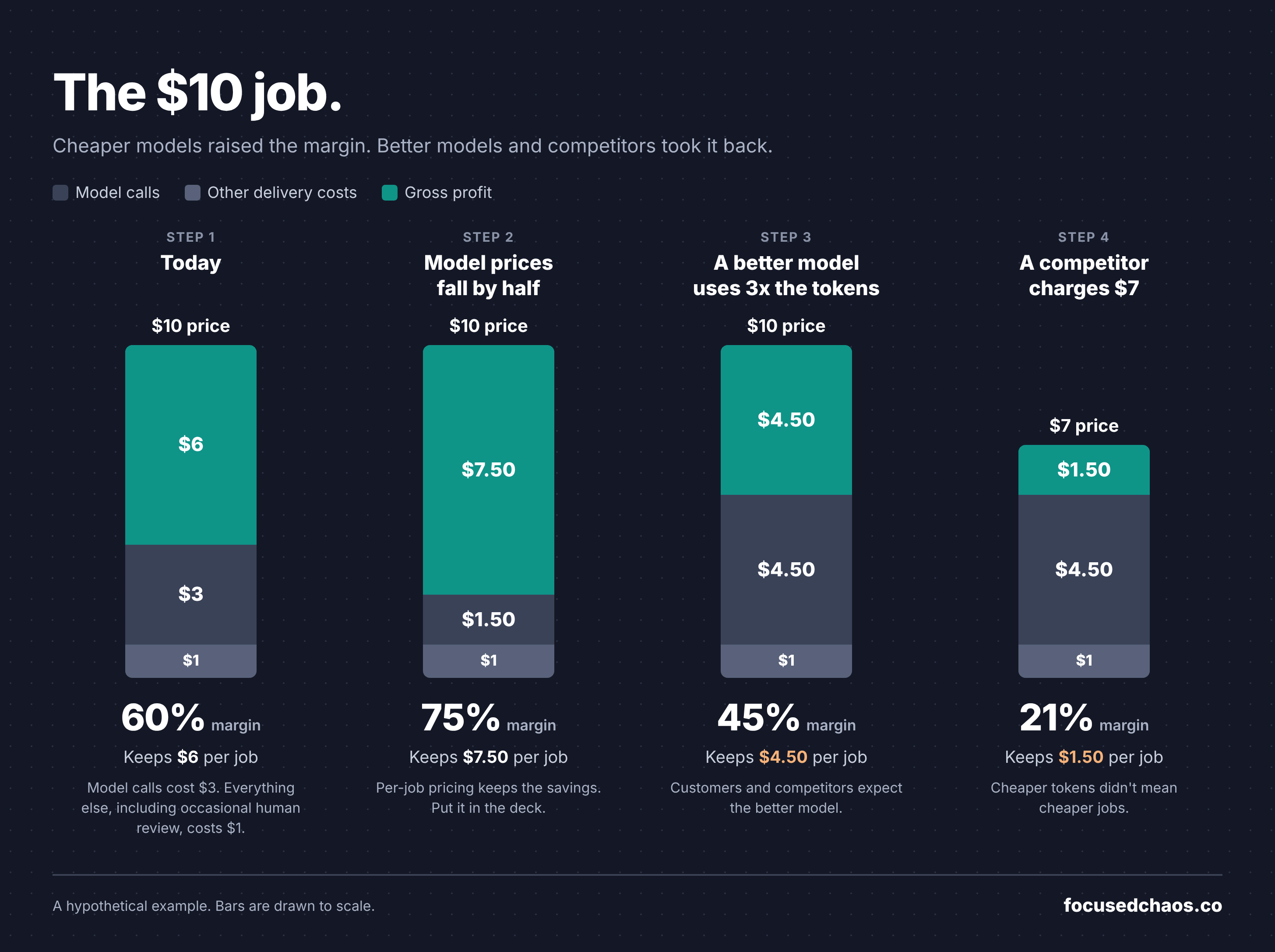
Say you charge $10 for a job. It costs $3 in model calls and $1 in other delivery costs, including occasional human review. You keep $6 in gross profit.
Model prices fall by half. You’re now spending $1.50 on model calls and still spending $1 on everything else. You keep $7.50. Beautiful.
Then a model comes out that does noticeably better work and uses three times as many tokens. At that lower token price, you spend $4.50 on model calls and another $1 on delivery. You keep $4.50.
Then a competitor starts selling a comparable job for $7. You match them. Now you keep $1.50.
This isn’t far-fetched. Cursor, the AI coding tool, changed its pricing in June 2025 because “new models can spend more tokens per request on longer-horizon tasks,” according to chief executive Michael Truell. GitHub hit the same problem with Copilot, its AI coding assistant. Customers paid per request, so a quick question and a multi-hour coding session cost them the same, even though the long session cost GitHub far more to run. Mario Rodriguez, GitHub’s chief product officer, said that model was “no longer sustainable.” In June 2026, GitHub switched every Copilot plan to credits that get used up based on how many tokens each request consumes.
I’d still consider switching to the better model. If customers use more of what it produces and come back more often, it could be worth it. Measure it first. You need to know, through your own evals, if quality goes up with the new model. That’s not always the case. You also need to keep an eye on cost and make sure you can maintain margins.
Customers want to know what they’ll pay
Cursor learned this the hard way. When it changed its $20/month Pro plan in June 2025 to reflect what each request actually cost to run, some users hit their limits after a few prompts, and others got charged for overages they didn’t expect. Cursor refunded the unexpected charges and apologized for how it explained the change. Cursor had a good reason for the change, since some requests cost far more to run than others. But its customers had no way of knowing what a request would cost before they sent it.
Customers don’t want to pay for things they don’t use (unused seats/licenses), but they also want predictability in what they’re going to be charged.
That’s why so few companies sell pure pay-as-you-go. Most are moving to a hybrid of some kind with a basic subscription and usage-based charges. Others are bundling credits into a subscription, where customers pay for a certain amount of usage per month (whether they use it or not). That’s basically the traditional software subscription model that still protects your margins. I tackle the AI credit model separately, although it overlaps heavily with pay-per-use.
At Candor, we have a subscription and per-usage fees based on interviews. We’re also testing enterprise licenses, because bigger customers are trying to set a fixed budget for next year, based on expected usage. For example, a customer might want to purchase 10 projects and 1000 interviews. Based on Candor’s pricing model, I can figure out a pre-paid, fixed “subscription” cost for that usage and track against it. If they go over, it could fallback to their credit card, or we’ll pre-emptively increase the number of interviews if they want to pay for more.
What makes pay-per-job businesses durable?
Everyone has access to roughly the same models. Most AI tools wrap tokens in credits, which makes the cost of each request harder to see. But some don’t bother hiding it. Gumloop, an automation startup, charges what the models cost plus an 8% fee, and GitHub now uses up Copilot credits at each model’s published price. If what you charge is mostly a markup on someone else’s model, customers can do the math, and competitors can undercut your markup. That’s a tough spot.
The stronger position is a unit customers already understand and already buy. When EvenUp charges a law firm per case, the firm compares that price to what the case work used to cost in staff time, not to the price of tokens. When Decagon charges per support conversation, customers compare it to what a human agent costs to handle one. That lets you hold your price longer as your costs fall.
It doesn’t last forever. Competitors will offer the same job for less. Customers may try to take the jobs in-house, believing that most of the value is the underlying LLMs. What keeps customers is output they trust, becoming part of how they get the work done and getting better the more they use you.
The question is whether customers come back because you’re the best way to get the job done, or because you were the cheapest this month.
Back to the grant application
If those nonprofits come back at the next funding deadline, I’d want to know what made them choose the tool again. Maybe the first draft saved them a day. Maybe they built their workflow around it. Maybe everyone else raised their prices.
That’s a much better conversation to have than whether you can multiply your first month by 12.
Most of the evidence on the pay-per-job business model is early. The retention benchmarks have small samples, and many margin figures come from surveys or companies themselves. But the questions are clear. Are customers coming back when the job comes up again? Are they using the output? Does every paid job make money, including the free ones and the failures? What happens to your costs when you switch models? Can customers predict their bill? And how much of your “ARR” is actually committed?
The model only works when you understand and validate usage frequency, while trying to give customers clarity on their spend.
The two-page local grant vs 40-page federal application example is the sharpest point on defining a job. A tactic for any per-job price list is to publish two or three size tiers with a plain-language checklist of what lands in each, so the customer picks the tier before the work starts. How do you handle Candor's pricing when a single research request balloons in size: do you cap the job, or let usage stretch?