People spend too much time debating the “right AI tool for the job.” Should you use Lovable? Cowork? Claude Code? What about Cursor, Replit, Codex, Base44, or whatever launched this morning?
The short answer is, “yes.”
I’ll share how I use Lovable, Cowork, Claude Code and ChatGPT. But I’m not married to any of them. New or upgraded tools show up regularly, I test them, and I’ll switch when something’s better. The real answer to “which AI tool” is boring and true: use whichever ones you want, because the point is to learn.
I can’t hand you a tidy chart that maps every tool to every job. Those posts are silly and they rot within weeks, because the tools change too fast. You only figure out your own toolkit by building with it, not by reading comparison posts. This one included. (But please keep reading!)
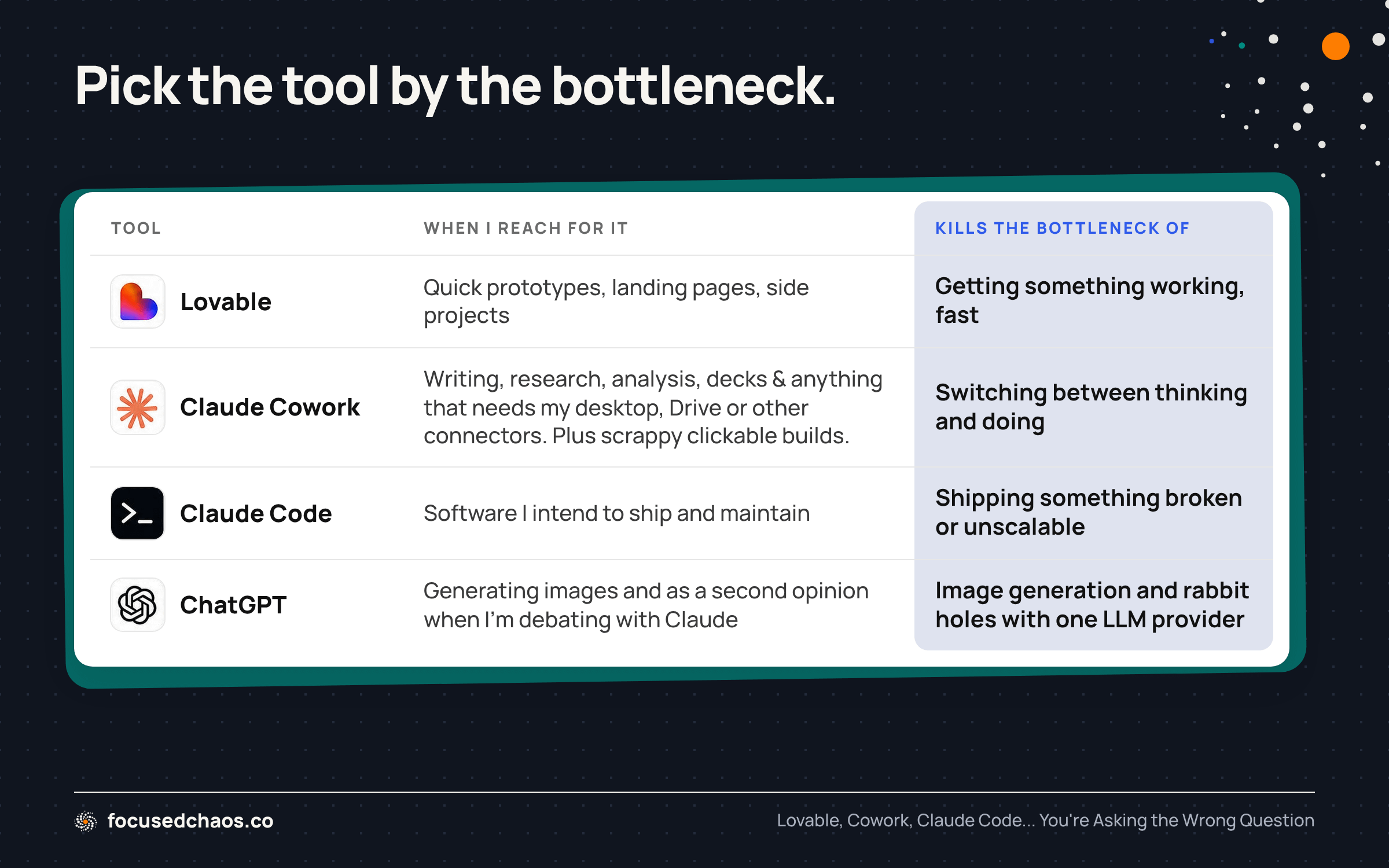
One thing that did help me: stop thinking of these as competitors and start thinking about what each one is really good at removing from your path. Every tool kills a different bottleneck. Lovable kills the time it takes to get something working. Cowork kills the wall between thinking and doing. Claude Code kills the risk of shipping something broken (if used properly). There’s overlap between them, but once you see it this way, “which tool” stops being a loyalty question and starts being a “what’s in my way right now” question.
Here they are, easiest to hardest to learn.
Lovable: get something real, fast
Lovable is the simplest on-ramp. You describe what you want, it wires up the database, uses built-in LLMs, handles deployment and after a few minutes you’re clicking around a real thing. When a newbie asks me how to start building with AI, I send them here. They’re always amazed (because it’s amazing!)
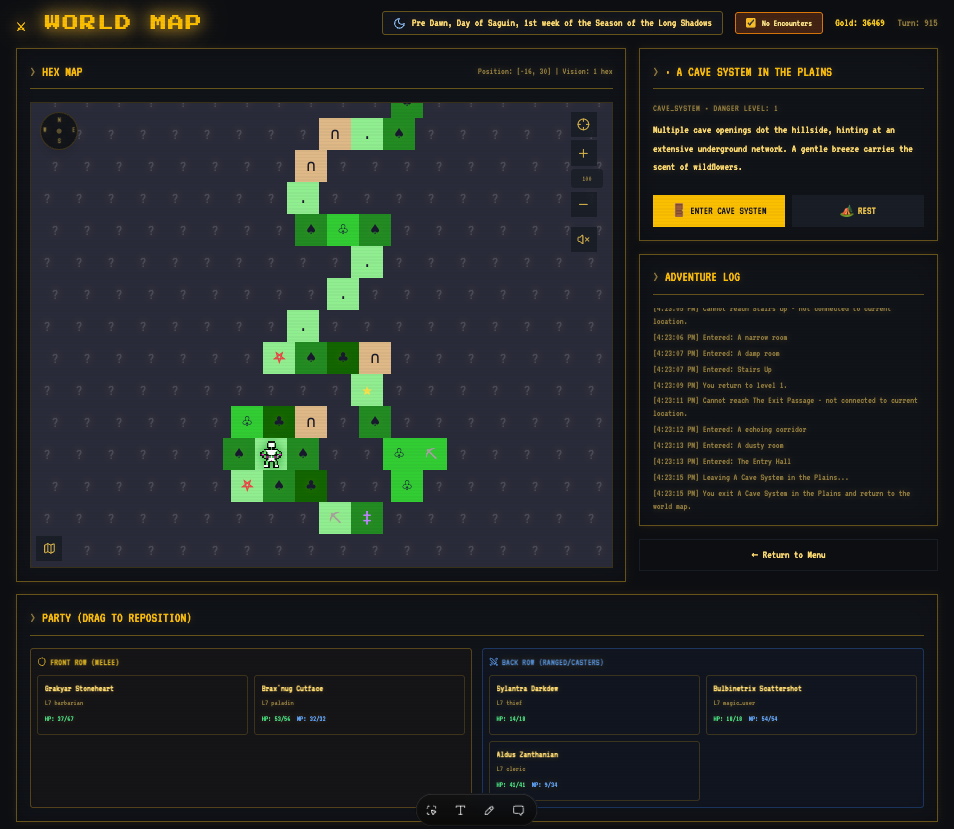
Don't file it under "toys." I built a complete corporate venture studio builder in two days with it (learn more here). Last year I started building a sophisticated fantasy RPG in it: AI-generated map, thousands of items, hundreds of skills & spells, complex combat rules and more. Lovable does sophisticated work.
The trade is that it makes most of the decisions for you. That’s why it’s fast, and why you learn less. You’re not choosing how the pieces fit. Perfect when your only job is getting something in front of a human.
My most complicated Lovable app is a D&D game
Last year when I first got into Lovable I decided to build a robust fantasy game. It still needs lots of work, but it’s been insanely fun to build.
Some of the cooler features (imo):
Music that changes depending on the setting
City builder back-end where you can custom-build specific locations
Decision paths that allow you to do class specializations
A complete pantheon setup (courtesy of my old MUDding days)
If you’re interested in trying this out, message me. 😊
Cowork is where thinking and building stop being separate activities. I write in it, research in it, build decks and work through analysis in it. That’s the part people know. What surprised me is how much it also builds.
Recently I made a multi-page marketing site for a client (copy, calculators, and more) that started in Cowork. I used it to pull logos off the web, strip their backgrounds, and lay out the pages.
Another recent build: a complete clickable prototype of an enterprise e-commerce product. No database, no auth, just flat files and interactivity, exactly the scrappy prototype you’d otherwise reach for Lovable to do. I ran it through Cowork on purpose, to find the edges. It held up well.
The one thing I don’t do in Cowork is images. I’ve tried, and they’re meh, so I generate those in ChatGPT and drop them in. Different tool, better result, no loyalty required. That’s the whole philosophy in one small task.
ChatGPT for second opinions
Sometimes I get into debates with Claude and need a “second opinion”. So I ask ChatGPT. I find it helpful to get a different perspective, from a different model.
You can use one LLM for most of your work, and use a second LLM as a critic or counterbalance. I know the models are autocomplete machines, but it’s easy to get value from comparing and contrasting their output.
What makes Cowork different from Lovable is reach. It’s plugged into my desktop and Google Drive. It works where my actual files and workflows already live, which means it’s often less about “building an app” and more about killing the twenty context switches a real task usually takes.
Claude Code: correctness, and the real story
Claude Code is the steepest climb, and it can do the most. It’s where things go when I actually believe in them.
Early on it drove me nuts, because it loves to declare victory before the job's done. You ask for a feature, it grinds away, then announces "all set" like an over-eager junior who never checked their own work. Better prompts barely moved the needle.
What fixed it was forcing it to define “done” before it starts. Three to five specific, pass-or-fail checks, written down first. Then a separate agent grades the work against them, one at a time, citing evidence. No scoring out of ten (a “7” just starts an argument with yourself). Pass or fail. If something fails, it stops and tells me which check and why. It doesn’t get to judge its own homework.
It’s important to recognize that you need to put a lot of work into ensuring Claude Code does what you want. Roughly 20 to 30% of my Claude Code time isn’t spent building the product. It’s spent harnessing Claude Code: the commands, the reviewers, the hooks, the rules.
AI hasn't eliminated software engineering. It's moved it upstream. I spend less time writing code and more time designing how the AI writes code. The leverage isn't learning Claude Code. It's teaching Claude Code how you work. Your setup becomes the product.
I put my whole workflow and setup on GitHub and wrote it up here. Every rule in that setup is a scar. Your config ends up reading like a list of mistakes you’ve agreed never to repeat.
Claude Code is wired for more than Cowork. Custom commands, hooks, configuration you build yourself. I've got one that wraps every session, saves my notes, and refuses to quit until my work is safely stored. Claude Code requires that you do more work: connecting the LLM of your choice, setting up the database, deployment infrastructure, etc. That's the price of looking under the hood, and it's worth paying when the thing has to be real.
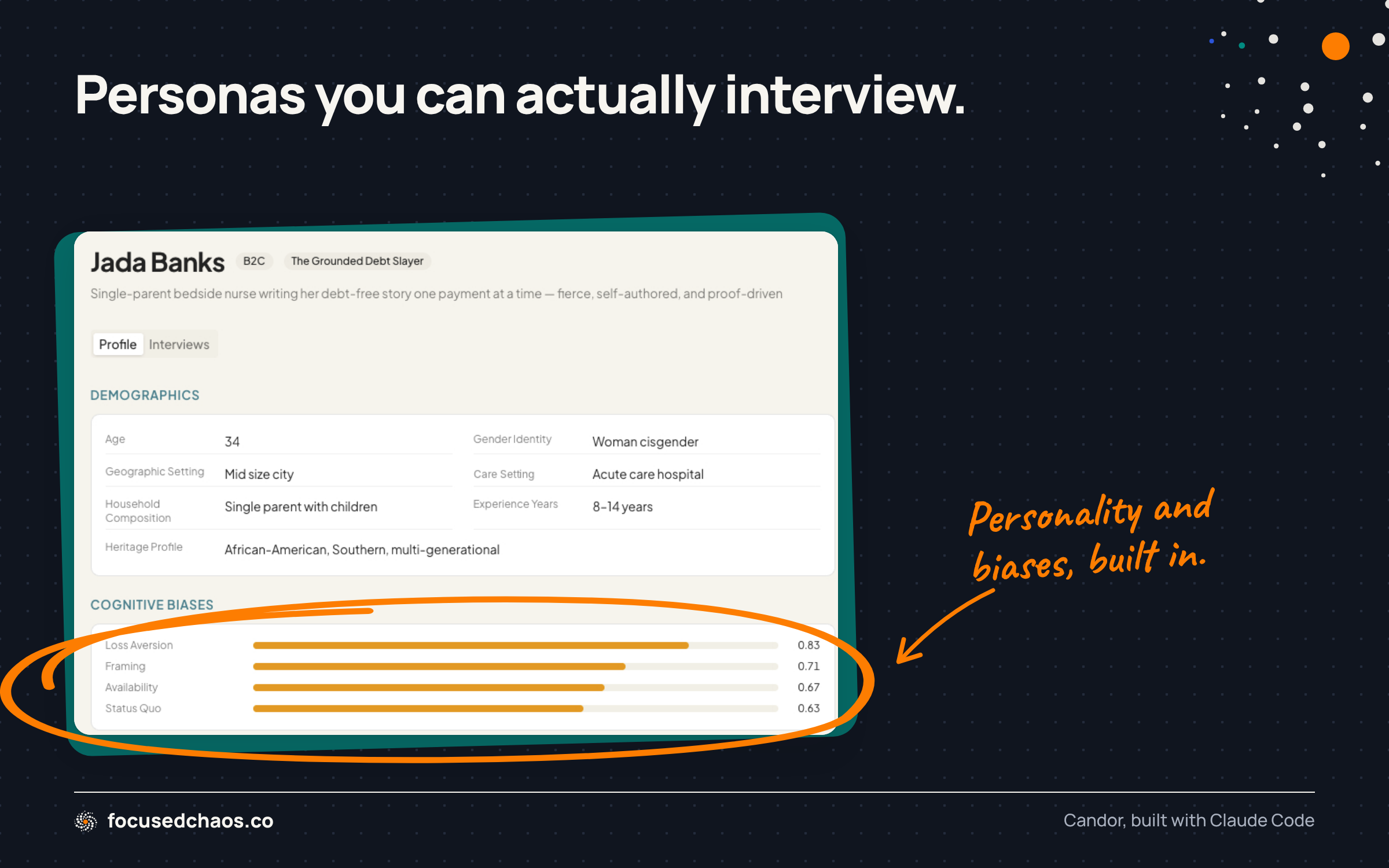
My most complicated project with Claude Code is Candor.
Candor is a synthetic user research platform. It allows you to create digital personas (with your own data + Web search) and interview them for problem discovery, problem validation, concept testing and price testing. You can interview the personas manually, or have the AI Interviewer Agent do it. Everything is summarized into a comprehensive, actionable report.
Wanna try it? We’re open to beta testers now. It’s great for researchers, product managers, marketers or corporate innovators looking to do more research on a regular basis.
I still prototype quickly in Lovable. It’s the most convenient tool and plenty powerful. But just because you start in one tool doesn’t mean you can’t move to another.
In a few cases, here’s what I’ve done:
Start in Lovable.
Connect the Lovable project to GitHub.
Ask Claude Code to clone the GitHub repo and work with it.
That’s a seamless way to move from a quick prototype to production-grade software, if you want to jump between Lovable and Claude Code.
Here’s my “cheat sheet” (today)
I just spent this whole post telling you there’s no clean answer. And there isn’t. But I want to make this as actionable as possible, so here’s how I split it right now. Use what you can, then outgrow it.
I should point out I use other tools as well, including Claude (chat), Perplexity (web search & research) and a host of others for the software I’m building: Tavily, Sentry, Vercel, Apify, Supabase, GitHub, Resend, Cloudflare, Inngest and more.
The actual point
Six months from now, nobody will care whether you started in Lovable, Cowork, or Claude Code. IMO, they shouldn’t care now. They should care about whether you shipped something useful, and whether you got smarter building it.
The people making the fastest progress aren’t hunting for the perfect tool. They’ve used enough of them to know, in their gut, which one fits the job in front of them. Sometimes that means jumping between three tools in an afternoon. Sometimes it means staying in one for a month. The switching was never the point. The judgment is.
So stop reading comparison posts (yes, this one too) and go build something this week. Which tool should you use? Doesn’t matter. Anything else is procrastination dressed up as research.
Hi Ben. Great share and perspective on bottlenecks and the durability/longevity of tools. Your experience mirrors my own path: ChatGPT was the on-ramp for anything more involved than a basic internet search, and led me to configuring 10 customGPTs across different parts of my life (e.g. product strategy, travel planning, a financial sounding board, etc.) showed me which ones actually deserved to become real agents. Now I'm migrating those into Claude: Cowork for the ongoing contextual learning & works; Code for the agentic apps that have earned the right to actually launch. Similar arc you describe, just a different starting stack. (P.S. I helped my wife build a vacation rental site on Lovable. And I kicked the tires on Cursor during vibe coding's 5-minutes of hype/fame, but finding Claude is suitable and easier to have a single dashboard covering my general use cases, as per above).



Hi Ben. Great share and perspective on bottlenecks and the durability/longevity of tools. Your experience mirrors my own path: ChatGPT was the on-ramp for anything more involved than a basic internet search, and led me to configuring 10 customGPTs across different parts of my life (e.g. product strategy, travel planning, a financial sounding board, etc.) showed me which ones actually deserved to become real agents. Now I'm migrating those into Claude: Cowork for the ongoing contextual learning & works; Code for the agentic apps that have earned the right to actually launch. Similar arc you describe, just a different starting stack. (P.S. I helped my wife build a vacation rental site on Lovable. And I kicked the tires on Cursor during vibe coding's 5-minutes of hype/fame, but finding Claude is suitable and easier to have a single dashboard covering my general use cases, as per above).