


AI is fundamentally changing how businesses work and make money. And things are just getting started.
In 2013, Alistair Croll and I published Lean Analytics, a book about using data to make better decisions. One of the most popular parts of the book was our business model diagrams. We mapped six business models: freemium Saas, e-commerce, mobile apps, user-generated content, marketplaces and media sites. The focus wasn’t exclusively on how these businesses make money. The focus was on understanding the whole business, each moving part and how one part affected another. Everything is a system.
We described each business model in-depth, drew diagrams to understand user/customer journeys, and identified a set of key metrics that matter, depending on the stage of your business.
Then along comes AI…
Suddenly, we have a host of new business models that warrant investigation.
I started exploring this further with a simple version of a usage-based product, using Candor as my case study. I published it as “Model 7” in my post on systems thinking.

On LinkedIn, Alistair was gracious enough to suggest that I’d just written the missing chapter of Lean Analytics.

This wasn’t quite the missing chapter, but got me thinking…what are the new AI business models and how do they actually work?
With that in mind, I dug in.
Introducing AI Business Models

This is a new website with 8 AI business models that are defined and mapped.
The content isn’t as thorough as Lean Analytics, but it’s an interesting starting point.
How to use AI Business Models
The website lists each of the AI business models:
Model and inference APIs (e.g., OpenAI, Jev, Fireworks AI)
Consumer AI subscription (e.g., ChatGPT, Midjourney)
Subscription for usage credits (e.g., Lovable, Clay, Moselle)
Pay per job (e.g., Crosby, Candor, EvenUp)
AI add-on to existing SaaS (e.g., Microsoft Copilot, Notion, Canva)
Outcome-priced AI agents (e.g., Fin, Sierra, Chargeflow)
Ad-supported AI (e.g., ChatGPT, Amazon Rufus, Koah)
AI-native services
It’s a comprehensive list, but not necessarily exhaustive. AI business models are evolving quickly. It’s tough to keep up.
Each model has a detailed description, metrics that matter and a systems diagram.
The site gives you a walkthrough for how to select the right model(s) for your business. Most companies leverage at least two models at a time, which is exactly what we uncovered with Lean Analytics as well. It’s rare to find a company using one model. Things are even more complicated today.
Each systems diagram can be downloaded as a PNG, PDF or PPTX file. The PPTX files are easy to update, which you’ll want to do, to customize them to your business.
The site also has a News section, which updates weekly with curated information about AI business models. If you want to stay up-to-date with things, please subscribe.
My hope is that people see AI Business Models as a genuine resource that they come back to over and over. I intend to update things regularly.
How to read a business model diagram
The business model diagrams represent a high-level, but complete view, of how each AI business model works.
Here’s an example:
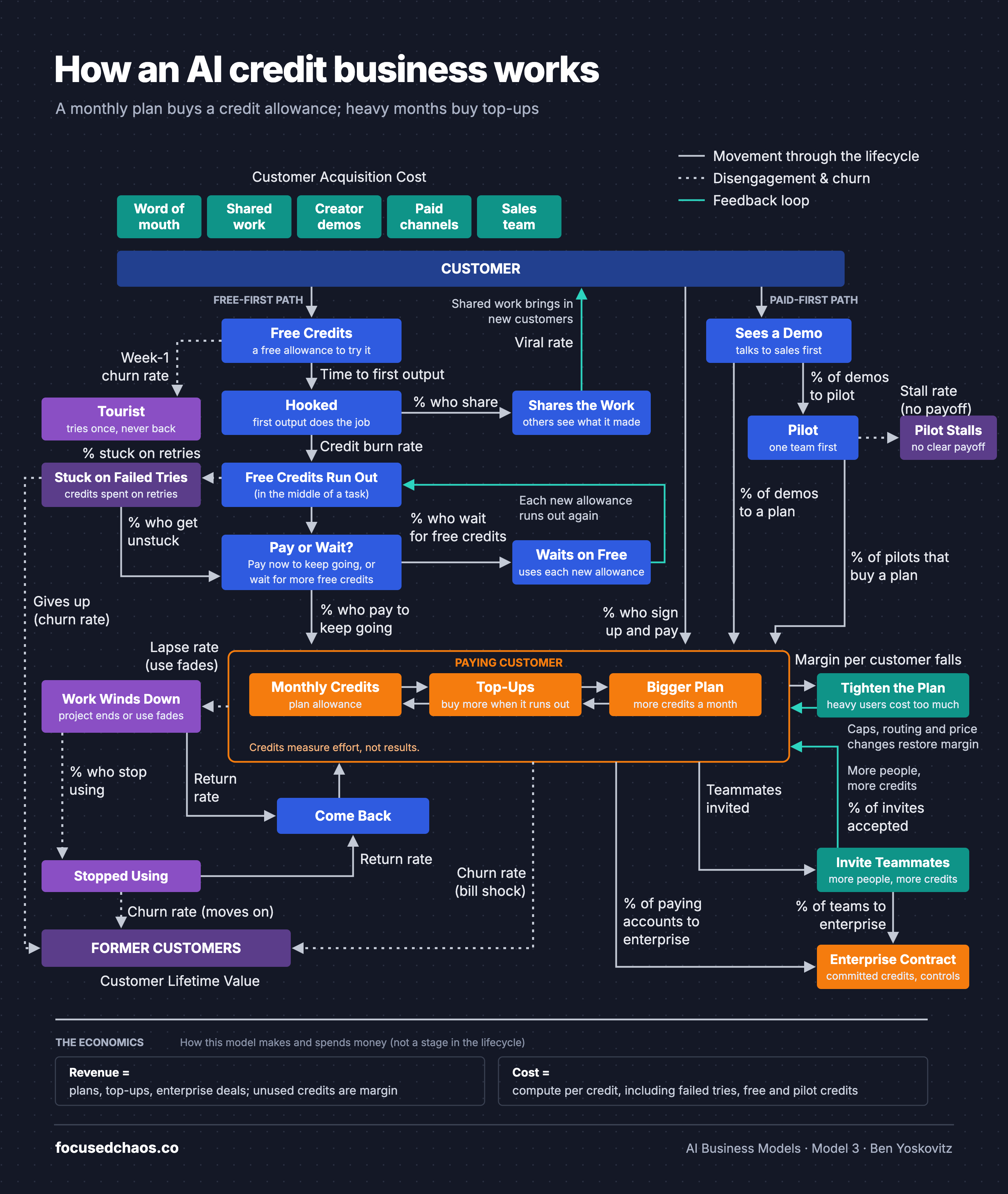
I know that’s not easy to read or digest, but you can download the file, or zoom into it on the site.
Read the diagram top to bottom, starting with how users/customers are acquired.
In this case, I’ve mapped two approaches to customer engagement: a free trial with free credits, or a sales-led approach. That definitely adds complexity to the diagram. It’s also a good reminder for why you need to customize the diagrams to your business.
Imagine a user/customer flowing through the diagram, where the movement between steps is represented by a metric.
Not every single detail is mapped. For example, the diagram assumes the customer sees a demo, runs a pilot and converts. That might require multiple sales calls. Technically, each of the business model diagrams could have multiple levels, where you double click into, or zoom into, specific sections to see more precise detail. I didn’t map out those details, but you could (and should) when designing your own business models. When you do that you truly start to understand every step and flow through your business, and where there may be bottlenecks.
The goal is to understand the system, not just one part of it. Then, it’s important to decide where to focus. Pick one area of the map that’s the most troublesome, and work to fix it. Once that’s done, you can logically move to the next part of the map and fix that. And so on.
Things I want to add to the site
There’s a lot more I can do with AI Business Models. Here are a few of the ideas I’m pursuing:
A business model generator: An AI-tool that would take your inputs and help you map your customized business model.
More case studies: I’ve used Candor as a case study, to demonstrate how models blend together, but I want to publish more case studies. Lean Analytics had some great case studies that brought the concepts to life.
Metrics per stage: In Lean Analytics we defined 5 business stages (Empathy, Stickiness, Virality, Revenue and Scale) and there were specific metrics to focus on per stage. The site might list those metrics, but doesn’t organize them by stage. Once I’ve got metrics per business model per stage, I can help identify the One Metric That Matters at any given point in time.
More benchmarks: Each business model has a few examples and benchmarks for metrics, but it’s not comprehensive. In some cases, there isn’t enough data yet, or I could only find anecdotal data. Eventually, I could see the site having up-to-date benchmarks for every key metric.
A survey: I’d like to collect more data from people on what business model(s) they’re exploring. I want to understand how people are pricing their products, integrating business models and figuring things out.
If you have any ideas for how to improve the site, please let me know!
AI is fundamentally changing how businesses work
Thank you mister obvious. AI is pretty much changing everything. Some of that’s good, some less so. But here we are, in the midst of insane change, trying to wrap our arms and brains around it.
From a business perspective, AI changes the very fundamentals of the work we produce and the value we create for others (and ourselves). It changes expectations (and is doing so faster than I’ve ever seen).
If you’re building an AI product, you have to completely revisit everything, from how you on board users to how you monetize. AI is leaving no stone unturned. But it’s still extremely new and unclear.
Each of the eight business models I’ve defined have historical precedence. For example, there are lots of companies built on ad revenue. We understand how ad revenue businesses work. But ad-supported AI businesses? Very different, and still unproven.
SaaS (software subscriptions) has been a mainstay for twenty years. What about subscriptions for usage credits though? Similar, but different. And the new subscription model for AI use is in flux. Even the concept of “a credit” is fuzzy, because it’s a made up way of defining some amount of use.
With all of this change, I thought it would be cool to centralize AI business model information, with a Lean Analytics lens. Hopefully others feel the same way!
You can check out the site today at https://businessmodels.ai.
Outcome-priced agents are the model enterprise buyers ask about most, and the hardest one to price honestly.
The outcome has to be something the buyer already counts, like reconciliations cleared or regression testing hours cut. If you have to invent a new metric to bill on, the CFO spends the whole renewal arguing about the metric instead of the value.